Episode 14
6 minutes Why Founders Fail to See Their Product Like Customers Do!
Rohaan Kaul, Founder, Zavops
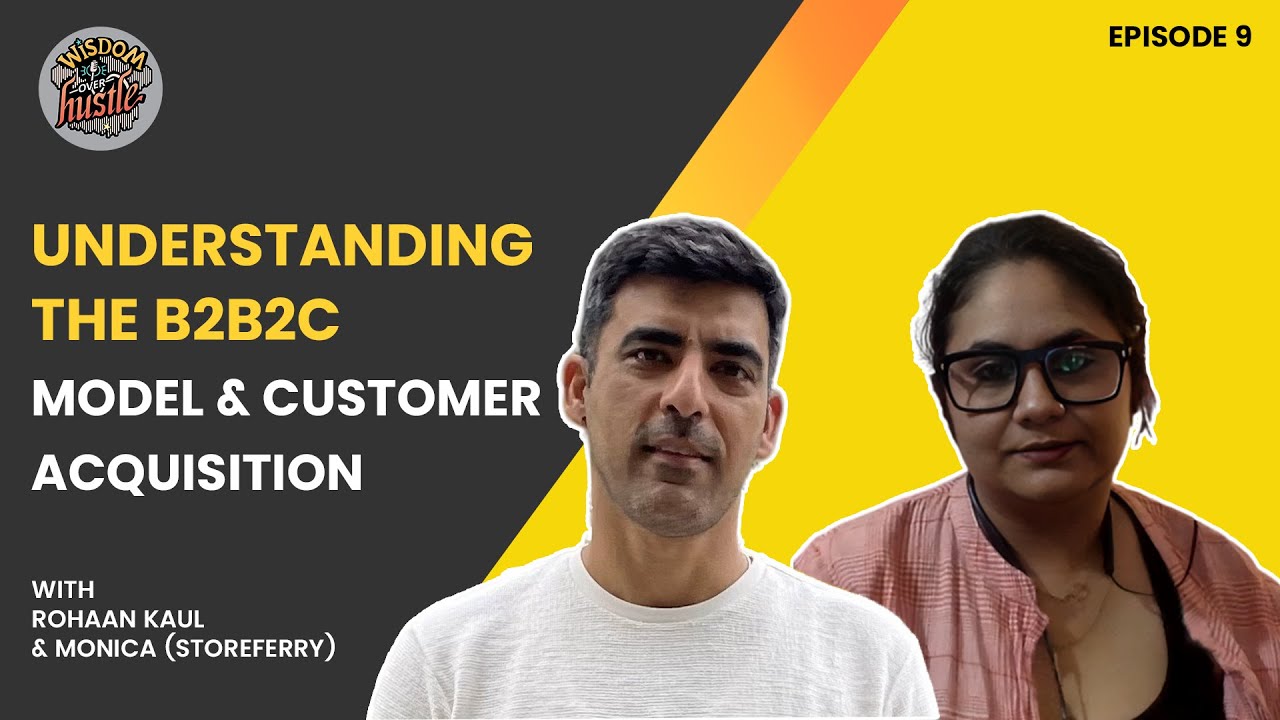
Exploring the future of facility management and marketplace innovation. Discover how technology is transforming the industry and creating new opportunities.
Hosted by
Rohaan Kaul (00:03.061)
Hello everyone, welcome back to another episode of Wisdom Over Hustle. I am your host Rohaan Kaul and today we are again with a guest on our show, someone interesting, someone different and we will talk about wisdom over hustle. So today I introducing someone who is a dear friend and who is doing something really different and innovative in the sense, she is working in a male dominated industry.
and she's making waves over there. She's kind of breaking the glass ceiling over there. I have my friend Monica Shahi here, who's the co-founder of StoreFerry, which is a marketplace for facility management. And this is a very interesting story for the reason that this is among the few companies that I found were operating on a B2B to C model. And today we are going to discuss
more about this very interesting model of how they operate and how they've been able to generate revenue using this innovative model, reach out to their end customers using this model. And more importantly, we are also going to discuss on something traditional like a facility management industry, how AI and the B2B2C model with AI is going to work in this industry.
Welcome Monica, thank you for your time. I know you are very very busy chasing investors but thank you so much.
Monica (Storeferry) (01:32.462)
Thank you so much Rohan. Thank you for such a generous introduction to be honest. I think the boasting has helped me, you know, increase my confidence. So I'm pretty much sure this session is going to be amazing. Thank you for an amazing interview.
Rohaan Kaul (01:49.501)
Alright, so, okay, so before we begin then, okay, I know you have a background in industrial engineering. You studied from Ramaiah right? Okay, like we come across so many founders, you and I, when we go out and meet at the events, we meet so many techies who are turned into entrepreneurs, stories like us, right? But,
Monica (Storeferry) (02:00.748)
Exactly.
Rohaan Kaul (02:15.125)
I mean this is really interesting from a point of view like industrial engineering. Like typically, you know, I mean when we were studying we would not find women. I mean I don't want to sound misogynist over here but it's an observation like you know, things like Civil or all of this, you know. I mean even if I've seen somebody take up industrial engineering, they've not walked the conventional path.
Like you know they've probably chosen a career in IT or tech or something of that sort, right? Whereas as far as I know your experience, you work in this industry like the industrial engineering industry itself and that is the reason why you've come to a place where you are working, you have store fairly now. So tell us this whole journey, like you know how it has been, how it has come to this point where you had this wild hour moment that you know you want to do something.
around us and the Storeferry was born.
Monica (Storeferry) (03:15.598)
So I guess it's a long story. I'm just collecting my thoughts on this right now. yeah, let me start with the fact that I've always been unconventional, feel. although my father was like, you know, go for mechanical because he was working in with Indian oil and he had seen mechanical engineers on very top positions. meets like, know, Monu, like that's what they call me at home. And they're like, Monu, please go for mechanical.
and I cleared my Comet K and came back, came to Bangalore and we didn't have Mechanical during that time, all the seats were filled. I was one of the top 2000 brands during that time. And then the nearest to Mechanical was Industrial Engineering. So I'm like, okay, fine, let's do that. But to be very honest, till now, even I see people who actually go into this particular segment of engineering.
They feel first they join it because first year is same for everyone and then in first year they come to they actually come to know what is industrial engineering. Now if you actually see in the industry what the industrial engineering people we do is we create procedures online assemblies on management about companies. know how what would be the optimal procedure in order to you know reach the targets.
So that's how it all started and then post which I got placed with Marriott which is a five-star chain and I was first of the okay I'm allowed to boast I feel over here so I'm just gonna say this that I was absolutely I'm like I should be boasting so I was first female engineer hired in Marriott and and the dream place Goa that's where I was placed
Rohaan Kaul (04:55.029)
Go ahead and go ahead.
Rohaan Kaul (05:10.281)
Wow, nice.
Monica (Storeferry) (05:10.478)
So amazing two years of my life, got to learn a lot. I have worked with Chief Engineer who was 65 and had opened approximately 15 hotels during his lifetime. And I worked with some senior leaders of Marriott, who was director of Marriott. And what we did was during that time, Starboard and Marriott merger was happening and Marriott went, okay, fine, we are going to go paperless.
and they started to implement all the softwares during that time. if you know, actually currently, Marriott is a completely paperless, operational-led company in the hotel industry. So I was a part of that project where we were implementing Transcendent in Marriott, of course, engineering departments. Then post which I came into consulting. I was working with this company called Ant Consulting.
So while I was there in these areas while I was transferring from an operational background to a consulting background, that's where I realized that how two of them, they should be actually talking to each other, but that's not happening in the market right now. So while we were there in Marriott, we found out that there is a lot of problem with the procurement. And see, what happens is once the project is done, the material is over.
inventory is over. Now every time there is a problem you have to reorder, reorder. Maintenance is a recurring job and one of the quotes that I would like to tell which was told by Mr. Herdman, my chief engineer long back, maintenance is the thankless job because you have to constantly do it and it's constantly there and nobody is going to come and tell you did a great job. They'll be like okay this is done but this is still pending. Things are always pending there right. So then I met
Mr. Mushkinwali, my co-founder. And we were working on a small project for ISPR during that time, which was a visitor management project. And that's when we actually realized that how much problem is there in order to procure these kinds of materials. That's where we actually thought of StoreFerry. So initially, our idea was completely different, Rohan. Trust me on the fact, for starting,
Monica (Storeferry) (07:29.646)
three months actually what we were doing is, sir, you need quotations, know, we will give you three quotations, you don't have to go to other vendors. Then we realized that the adaptability of this idea was not there in the market. Why? Because there's a trust issue there. Because if a single person is giving you three quotations, they don't know how much margin they have in the issue. Right? So then we pivoted and we came that what we want to do is we want to create a complete ecosystem into facility management.
When I actually talk about creating a complete ecosystem in facility management, is majorly that people like JLL, CBRE who are pioneering companies in this industry, they have been providing the manpower. But post that, there's a lot of operations in any kind of ability, right? So it starts from monthly procurement, yearly, you have to change a lot of things. You do things like transformer oil filtration, et cetera, et cetera.
Rohaan Kaul (07:58.964)
Okay.
Rohaan Kaul (08:18.303)
Mm-hmm. Mm-hmm.
Monica (Storeferry) (08:28.194)
So how the procedure works is it's a tedious, tedious procedure every time go ahead, get three codes, get three vendors, negotiate, you know, and the thing is people, the items, we are actually doing the long tail market currently. So the items that these people are preparing, they don't even have complete idea about what they want to purchase, right? So lot of conversation happens like over WhatsApp.
Rohaan Kaul (08:33.365)
Yeah.
Rohaan Kaul (08:38.27)
No.
Rohaan Kaul (08:52.542)
Okay.
Monica (Storeferry) (08:57.806)
people trying to figure out which model I want. So we wanted to bring some system into this industry. That's how we founded StoreFerry. we are a tech enabled one stop solution for B2B maintenance industry. As I would say in an analogy, Alibaba for maintenance industry. That's what we are trying to create. Your words, not mine. So thanks for putting those words in my mouth, I guess.
So, I mean, yeah, that's how it is. Absolutely, absolutely. So, yeah, here we are. 40 clients in Bangalore and I think we're doing pretty well.
Rohaan Kaul (09:26.523)
I... I haven't been paid for it though.
Rohaan Kaul (09:42.165)
Amazing, amazing. I hope your funding also comes in soon. At least then I'll get paid.
Monica (Storeferry) (09:48.042)
Absolutely. Come on.
Rohaan Kaul (09:49.813)
Okay, so at least now, know, while you and I were talking about a lot of things, I mean, of course, we talk a lot of things, but specifically about around this. And I was amazed. I was actually pretty amazed at the fact that you haven't spent a lot on the customer acquisition, like, you know, when we talking about the metrics of your business.
At that point of time, we came to a conclusion that the cost of acquisition is actually really low and it's very organic in nature. And it boils down to the fact that we did the reverse engineering of it and analyze your model, which was basically B2B2C. Now, is this B2B2C model by choice or this is by default how your industry operates? Or was it like because you wanted to spend less on the acquisition given the fact at this point of time?
you're a startup while you have received funds on everything but yes you have to spend with a little bit of jurisprudence and you know so was it like again coming back to the question whether it was by choice or whether it was basically by default how this industry or how this would operate in the near future also
Monica (Storeferry) (11:07.246)
So Rohaan lot of parameters over here. So we did made a choice of targeting this industry because first of all we felt that this is the industry which is actually suffering and it's a larger market to cater and it's the most cluttered market. So say for example if I go B2B2B, there there are corporates.
They have already set procedures to actually go and try to break that would be harder. The conversion rate would be higher. So currently we have a 68 % conversion rate. It is because of the trust that we built. So now when we started this, we started this completely via reference. We floated the idea in the market, first collected the requirement.
Rohaan Kaul (11:34.441)
Yeah.
Rohaan Kaul (11:49.012)
Okay.
Monica (Storeferry) (12:01.794)
first understood the psyche of the customer that how he actually wants his purchase to happen. I think a of companies what they do is they run to the market with their product and they try to push their product in the market. I personally feel after working in the industry is first you try to understand that how your customer wants to do the entire procedure.
And you make a product around it, not the other way around. So that's what we did. We reached out friends and we are like, hey, we are doing something like this. And then as I was starting to support my
Rohaan Kaul (12:32.585)
Mmm. Great.
Rohaan Kaul (12:55.317)
Yeah.
Monica (Storeferry) (12:55.892)
We were actually following up a different idea altogether. After three to four months, then we realized, okay, this is not working, let's do it this way. So that's when we came to know what our customer wants is best price, best quality, best after sales service. That's the biggest problem. Because a lot of things in this major industry comes with warranty. But then once I purchase, once it's not working, where do I live? Where do I actually claim the warranty? And if you actually know India's a very
sensitive country. So people are always like generally people who are facility managers and all they work in a smaller site they are paid somewhere around 40-50 and for 40-50k a month and I don't think so that's good amount of living plan for like 40-50k a month is something which is on a lower pay grade I feel. And these people what they have is
Majorly they work on these sites and they don't have those expertise tomorrow. They want to do any project they look around people So we want to do something like this. How do we go about it? They are not any be engineers just because in order to save the cost this is where the cost is So they also look for a lot of consultancy now we thought that why not bring all of it to one umbrella
Rohaan Kaul (14:16.437)
Okay.
Monica (Storeferry) (14:18.67)
hey we are doing something like this and once your idea is good, your product is good, your service is good it is unlikely the customer is not happy. So initial one year my retention rate was around 89 % and an yearly retention rate so I think we did good on that front and it was a choice that we made that we want to operate in this industry and this is how we want to do. We want the company to be sustainable. We don't want it to be
Rohaan Kaul (14:31.999)
Uh-huh.
Boom.
Monica (Storeferry) (14:48.334)
Hey, you know, let's just get the lowest vote. You know, let's just burn a lot of money. We have run the sustainable profit table and that's how we plan to go about it.
Rohaan Kaul (14:55.623)
Okay. Yeah.
Okay, so now, interestingly, I think so I've asked you this question earlier also, in B2B e-commerce, mean, this is typically if you put it under an umbrella, like it's basically B2B e-commerce, you have players like Udaan and Moglitz who are kind of already established in this segment. And then you have the more portals like, you know, your India Marks of the world.
and like them. So again, by focusing on a particular segment on a very specific this thing, A, I mean how easy or difficult it has been to make that, you know, early inroads. And two, now that you are on a very specific industry niche that you're talking about, right?
I think so from the investors point of view also you must be getting this question on the scalability part of it. How are you going to solve the scalability challenge in the coming times because I mean anybody who putting in the money they looking at bigger markets, how big it can scale up to. how are you tackling this? One is of course how easy or difficult it has been and two is the scalability challenge.
Monica (Storeferry) (16:01.134)
Absolutely.
Monica (Storeferry) (16:25.29)
So I think it has been quite easy for us to actually get into this market, to be honest. Why? Because of our network, to be very honest. I think when you are starting up anything, your network matters a lot in what industry you have worked and how many people you know, how many people trust you. So because we have worked in the industry, we already had that trust.
So I think that's where our initial challenges were not too much. But of course, when it comes to scaling, that's where a lot of companies, get stuck. So what we figured out that Refill worked best for us. We always, if I'm talking to any client, I'll be like, hi, sir, yeah, we did some much this, this, this, blah, blah, blah. And then I'll be like, I'll be happy to if you actually introduce me to someone. And they do actually, right?
If they like your services, they would go ahead and actually agree with their colleagues or friends or what all else. So that's there. And the second part of it where you actually told about the expansion. So I mean, I'm a numbers person, don't know how to tell a story, but I'm a proper numbers person. So let me get to the numbers of it. How big is the industry and which kind of industry actually we are targeting.
As I told you, we are targeting the long tail market. We are not targeting architects, interior designers, builders. Why? Because it's a one time thing. You take up a project and it's a one year project. That's it. End of it. Right. Now with the maintenance market, it's a record. So that's the reason when I say long tail market, it majorly means where the purchase amount might not be higher, but then the repetition of the purchase is happening.
every week there is some of the other things happening. So I mean yeah that's the thing. for the housing societies if I judge only just for the residential registered there are housing societies if I take there are 90,000 and here the average purchase goes up to three starting from three CR to eight to nine CR for a higher society as well. So now you can actually guess the market.
Monica (Storeferry) (18:47.758)
So instead of going to the papers and trying to search how big is the market, did a reverse calculation in order to understand how many societies are there and multiplied it with the average value that they do. And it has come to us that 3.8 billion dollar market, which is there in India, and growing at a rate of 13 % year on year. Because India is developing an infrastructure, even tier 2, tier 3 cities, that's happening.
I vaguely remember you actually mentioning Moglix and industry buying and India Mart kind of companies now. So Rohaan, our entire idea is lower time, best cost, best quality, and everything at one single stop. That's the entire idea. And Moglix, however, it majorly operates in the B2C market and it's a property form, but that's not how store ferry operates. What we majorly do is
There is a procedure that needs to be followed in this particular industry as well. We let the client follow that procedure. You're not telling them that you have to just add it to the cart and just buy the thing. You add it to the cart, you download your quotation, you to get approvals, you do it. You need consultancy, you let us know, we'll help you out. So it's more like a personalized service based kind of a thing that we actually give to our clients. That's how we position ourselves in the market.
And when we talk about companies like India Mart and Just Dial, again the same problem that we are trying to solve. Call the people, get the quotation, serve me, give the quotation, give the quotation kind of a thing. That's what we are eliminating. Everything at your fingertips within a short period of time. That's the idea.
Rohaan Kaul (20:33.703)
Okay, interesting. Now, now that you know, I'm trying to understand this model a little deeper, right? So in terms of leveraging AI, right? I know you guys are also playing around on the AI side of it. Now in this entire model, you've got one is the businesses that are in between and then you have the end customer also. like, you know, B2B2C model, right?
So in terms of taking precedence or in terms of leveraging AI on different touch points, right? Which touch point are you using in terms of probably giving precedence of leveraging AI or is it balanced out on both the ends? And how are you using AI on each of these touch points, whether it is a business touch point or it is the end consumer touch point? How is it working out?
Monica (Storeferry) (21:33.358)
So we had a huge product roadmap to be honest and we started with it. And I also believe Rohan that tech adaptability ratio in every kind of a segment differs. So as you told that we are the middlemen, we have vendors on one side and the end users on the other side. We had initially started with the automation part of it was based on the automation.
that how the orders are getting processed so that there is not a lot of human intervention on that side. And then when we actually, see everybody wants to get on the bandwagon with AI of course, and that's how you sell, know, we are the AI model of this and that and blah blah. So a while ago, if you remember, I was talking about the conservancy part which happens in this business. And there are so many laterals.
how I want to reduce my cost, how can I renew this with a lower cost, this, that, blah, blah, blah, so many angles into it. third thing is also about that this industry has a very low tech adaptability ratio, if you actually know that, right? Because there have been so many facility management tools which are coming to the market. A few of my friends, they run this company called Green Circle out of Gurgaon.
Rohaan Kaul (22:48.605)
Right. Right.
Monica (Storeferry) (23:01.184)
Amazing facility management application, but Indian customers, don't want to actually spend on a SaaS tool. That's the reason MyGate is free. It's free. That's how you get the customers, basically. You have to find different points of the revenue, how you're going to generate it. So what we had thought, we had spoken to our customers. And after working for two years in this industry, we had figured out
Rohaan Kaul (23:12.586)
Yeah.
Rohaan Kaul (23:19.839)
night.
Rohaan Kaul (23:26.506)
Huh?
Monica (Storeferry) (23:27.786)
Initially our idea was we list the entire catalog, let people add the things automatically and then probably just generate an estimate. Now what we are currently building is what we have observed even though people know what they want to buy but they can't find it. It's very hard because these are the people who don't even know how to write the spellings right or probably how to actually search the things.
Rohaan Kaul (23:46.151)
Mm-hmm. Right.
Rohaan Kaul (23:54.527)
Mm-hmm.
Monica (Storeferry) (23:57.262)
These are the blue collar workers who are actually trying to figure out some things. So here what we thought was instead now also how people send us the requirement via Excel sheet. They click the picture of things and they're like this thing, click the picture, this thing. So what we are currently going to do is that instead of sending the requirement and trying to add things to the cart, what we're going to do is give them that access where
Rohaan Kaul (23:58.005)
right.
Rohaan Kaul (24:02.687)
Great.
Rohaan Kaul (24:08.917)
Hmm?
Rohaan Kaul (24:14.035)
Like.
Monica (Storeferry) (24:24.046)
They can just scan the thing and be like, OK, fine, this is the product I want and this is the pricing of it. And I just want right in front of that. We are also working on a model where our AI model will be able to take care of the basic consultancy services which are required in this. If a person is building a new project or wants a renewal of EMC services, that's where we are trying to leverage. And of course, our back end, we want our back end operations to be completely under.
Rohaan Kaul (24:28.788)
Right.
Rohaan Kaul (24:51.518)
Okay.
Monica (Storeferry) (24:52.458)
very recently I met Harshal from Arali Ventures and that's where we also got into the talking and you know we got to the same point and I told him even his opinion was that in this kind of business where the tech adaptability ratio is low you have to train your customers to actually use the things right you have to slowly embed that in their you know day-to-day lives so
Rohaan Kaul (25:12.148)
Yeah.
Monica (Storeferry) (25:20.622)
What you initially do is you make your backend that strong. Your operations have to be completely automated. Your operation has to be driven by AI. And then later on on the customer side, slowly, slowly you make the customer adapt to the new things that we have. So that's how we are there on the bandwagon, but yeah, still rolling, still rolling, still getting it.
Rohaan Kaul (25:20.916)
Rape.
Rohaan Kaul (25:28.052)
Right.
Rohaan Kaul (25:36.104)
Okay.
Rohaan Kaul (25:42.419)
Right. So now that we talk about take adaptability, right. So now again, that brings me to a point where, okay, let's say the relationship between the B2C part of it, like in this entire, you know, where your facility management companies are in between and they are servicing the end customers, right.
Now even, know, we've been talking about the tech, probably the tech adaptability at that end is relatively higher as compared to the end side of it, right? So how are you envisioning AI and technology to work between that layer, right? And is there anything unconventional that you're doing in terms of, you know, driving that adaptability or, you know, something that
the tech or AI that you're playing with that is going to help on that end.
Monica (Storeferry) (26:41.166)
So Rohan, in order to drive the entire thing, not only with respect to the tech, we are building something called community of these people. Because we feel that although a large population in India works in this segment, but this segment doesn't have a community of people for IT, for non-IT jobs, for consultancy, everybody has a community. You have a community of big boards, have a community of IT people, have applications like grapevine, etc.
Rohaan Kaul (27:08.703)
Great.
Monica (Storeferry) (27:11.15)
But then facility management still seems very broken, the community seems very broken. So we are trying to drive our entire product through the community. Currently we have around 250 members in our community who are part of that, which is a bank or association of facility managers here. So I mean, I think that will actually help us. How? Because you train people.
and they claim them, their end users. So now the biggest problem in this market is, I should not be saying this, I don't know how to sweet talk on this, but the money under the table, be honest. That's the biggest problem. Exactly. So people don't want to be accused. Nobody likes getting accused.
Rohaan Kaul (27:56.319)
Ha! Right! Conventional kickbacks!
Monica (Storeferry) (28:07.842)
I think that's where we play a very strong role. That's how we build that trust in the market. Sir, we have got the quotation from Storferi. Yes, yes, sir. It is there or everything is there online. You can check.
Rohaan Kaul (28:11.498)
Ready?
Rohaan Kaul (28:19.349)
I remember the analogy that I gave you that if the only reason that somebody wants to go and attend the society meetings is the only reason they want to accuse somebody that you have taken from
Monica (Storeferry) (28:22.072)
you
Monica (Storeferry) (28:29.454)
Exactly, exactly, exactly. So I mean, that's the reality of the market. I'm not banging on the... So that's the reality of the market, right? That's how it works. So people like protecting their society. So I think that creating that cost transparency in the market is going to help us with the adaptation ratio. And with the facility marketing company, I'll tell you why the adaptation ratio is high.
Rohaan Kaul (28:35.689)
That's true, that's so deep.
I'm a doctor.
Monica (Storeferry) (28:59.362)
See, there's a lot of attrition in this industry. You get a client, he's there with you for several years. And then after that, he's getting a new mechanism. It iterates, iterates. A lot of attrition. So why does this happen? There are many more reasons how they are maintaining this, that, blah, But the reason being money taken on. So I think with facility management company, this also
gives them that kind of a leverage where they can go to their clients and they can be like, hey, our complete purchase happens to this company, this is a transparent platform, if you want to check their reach with other vendors, you can do that. So with this, they're also able to create that trust among their customers. And the acquisition rate goes down for them as
Rohaan Kaul (29:51.177)
Right. It would be great if your platform could have a gen AI that every time this accusation is thrown at something like the response that could be generated and sent to them. That integration of WhatsApp would be great fun. you know, the society coming. I tell you, told you time and again, I get my best entertainment from a society WhatsApp group. mean, way things.
Monica (Storeferry) (30:01.038)
god.
Monica (Storeferry) (30:15.79)
Amazing, right? How people are accusing.
Rohaan Kaul (30:20.135)
Yeah, yeah, the way things fly, they are thick and fast. It's amazing. And I think so if Gen AI could solve that, that would be great.
Monica (Storeferry) (30:25.678)
you
I am literally, that's one of the reasons you making this community give us five years. I'm telling you, you're gonna have a very good content, meme content coming up.
Rohaan Kaul (30:40.561)
Great, great. All right. All right, Monica, it was lovely having you on the show. think so we are about on time. We could go on and on and on, but you have to take a pause somewhere. So thank you. Thank you for your insights. think so, you know, from a conventional B2B and B2C, this is a refreshing change that you talked about, you know, the B2B to C industry and how AI is actually playing a
Monica (Storeferry) (30:50.318)
you
Absolutely.
Rohaan Kaul (31:08.425)
part in that and how you're prioritizing whether it is the B or the C part of it that needs to be, you know, given the AI experience, but it was lovely having you on the show and people who have more questions for Monica and they want to ask something specifically about starting up and things are starting up or, you know, making intelligent choices about the kind of marketing model that you want to follow. Monica's LinkedIn would be in the description of this video. You can pick it up.
bring her and get in touch with her. And for people, our lovely audience, please do subscribe, hit the bell icon and the next episode you will get a notification. We would have another interesting guest like Monica talking something about marketing and most importantly using wisdom over hustling it out. Thank you Monica. Have a great weekend. Bye bye.
Monica (Storeferry) (32:03.118)
Thank you so much, Ohani.
Rohaan Kaul (32:06.581)
Bye bye.
Monica (Storeferry) (32:07.534)
Bye! 74 % uploading.
Rohaan Kaul (32:12.341)
Stop.