Episode 14
6 minutes Why Founders Fail to See Their Product Like Customers Do!
Rohaan Kaul, Founder, Zavops
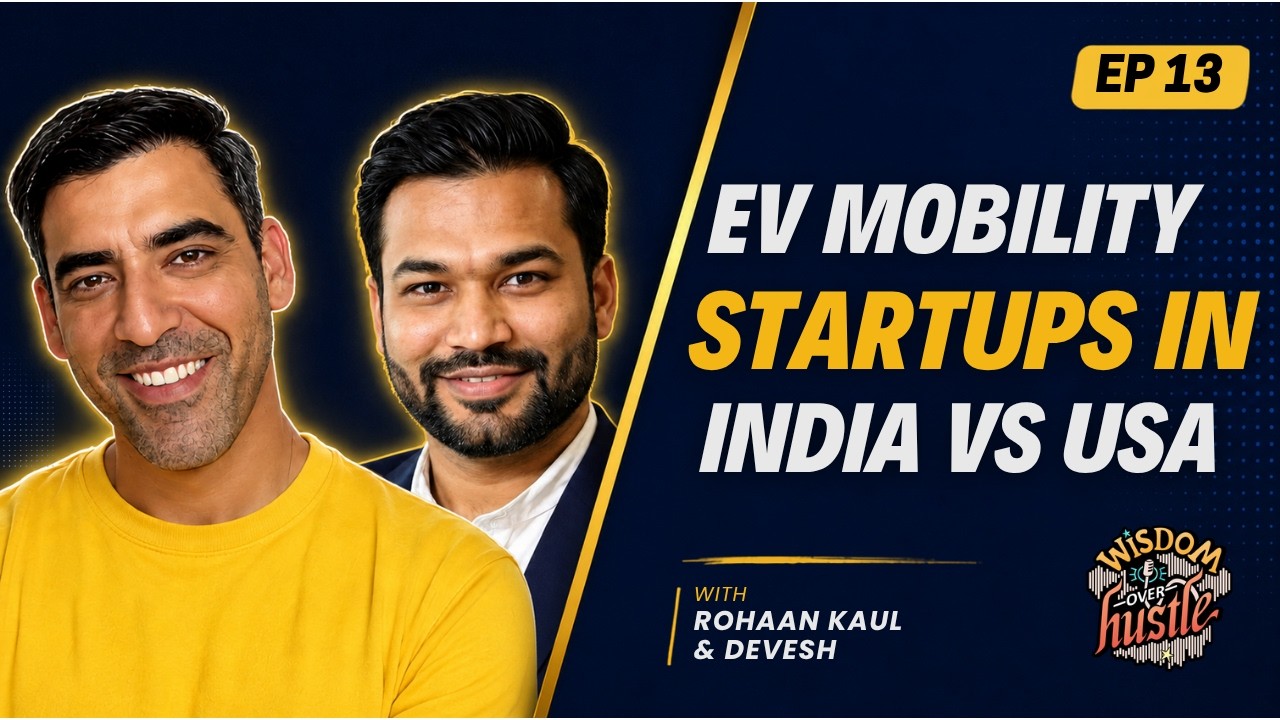
Explore how startups, technology, funding, infrastructure, and consumer behaviour are driving the next era of electric transportation.
Hosted by
Rohaan Kaul (00:01.39)
Hello everyone, welcome to another episode of wisdom over hustle. Today on our guest panel, I have somebody who's a disruptor in a real sense. know, a of founders call themselves as disruptors, but this definition would surely be applicable to him in a real sense. Just to give you a brief background.
I have with me tonight today on my guest panel, Devesh. So Devesh Jain is a founder and an entrepreneur. A quick background about him. He's been into EV and mobility space for more than a decade now. And he's worked on pretty cool innovating stuff in power drive and BMS battery development. If I tell you the
Brands that is worked with some of the coolest things in the industry like Fiat, Chrysler, Lucent Motors and Archer Aviation. From hyper cars to electric aviation, mean if I have to say this is like Tony Stark in true sense, building really cool stuff.
That's about him and now Devesh has actually moved from US to India and he is doing some ground breaking work in luxury EV segment, especially in the passenger car segment.
doing something innovative on the battery development where the battery life of the vehicle is increased by at least 3x, 3 times more. So welcome, Devesh. Welcome to our show. How was it today? Making you slog it out on a holiday, on a national holiday.
Devesh Jain (01:52.303)
Yeah, thanks, Rowan. No, the day is going good and can't ask for more than talking to you on this podcast. And thanks for an amazing introduction.
Rohaan Kaul (02:12.726)
Okay, I'll bring our connection from Gujarat over here. Did you enjoy Fakna Jalebi today?
Devesh Jain (02:19.919)
Not yet. am longing for it but I haven't had it yet. I did have the next best thing in being in Bangalore is Indioora sambar.
Rohaan Kaul (02:31.797)
Aha, nice, Alright. So, Devesh, now that everybody knows you, the Gujarati roots, moving to the US, coming back to India, how did it all happen?
Devesh Jain (02:47.406)
Yeah, so like I was born in Kota Rajasthan and then bought up in Surat, Gujarat. That's where I did my schooling until 12th. Moved to Jaipur for my undergrad in B.Tech, Mechanical Engineering. During my last year of engineering, I started doing research on additives in the fuel. Like you might have heard about ethanol addition in diesel and petrol these days.
Rohaan Kaul (03:06.733)
you Okay.
Devesh Jain (03:15.982)
We were working on it about 2014, 2015 at that time in the laboratory space. At that time, started working on hydrogen engines and hydrogen generation and hydrogen consumption in IC engine. My professor told me that we working on two advanced technologies to be tried and tested and validated in India.
Rohaan Kaul (03:35.789)
you you
Devesh Jain (03:45.837)
or many of the Indian universities or places. You can try testing it out in the places in Detroit, which is the automotive hub of the world. So I took that seriously and I went and applied for a colleges in Detroit region exclusively, or automotive universities. And then I landed.
Rohaan Kaul (04:06.96)
you you
Devesh Jain (04:13.666)
with scholarship at University of Michigan, the Dearborn campus in US. So that's how my journey began with respect to first testing out engines and other things and automotive, and then going into Detroit or Michigan, US.
Rohaan Kaul (04:33.548)
Any cool stuff that you made at Fiat Chrysler like cool cars, cool planes?
Devesh Jain (04:42.54)
Well, at Chrysler we were working on many advanced projects. So one of the most common ones which I tell people about, which I'm allowed to tell people about, a plug-in hybrid version of Chrysler Pacifica minivan. It's one of the most selling minivans in the world. And we launched the hybrid version, which increased the mileage and the power of the vehicle.
But not just that, one of the most coolest projects which I worked on at that time was vehicle to grid. So we were not just charging the batteries using your plug, but if at night or during the day, anytime your vehicle is at home, but your electricity goes out, your vehicle battery becomes an inverter and you could run all the loads like air conditioner, your heater, boiler, everything on the power coming from the vehicle.
Rohaan Kaul (05:16.684)
Okay.
Devesh Jain (05:40.588)
So it's advanced vehicle to grid technology. And we executed this in San Diego with other OEMs like Honda and another one is I'm not allowed to say about. But yeah, we did that demo. So that was pretty cool. Then this is back in 2017, 2018 when the world was still just talking about
Rohaan Kaul (05:55.97)
Okay. Okay.
Devesh Jain (06:07.817)
Vehicle to Grid as a very, very high level concept. We did a POC with like eight houses in a micro grid setup and four vehicles.
Rohaan Kaul (06:19.981)
Right. Any and what about when you're working with archer aviation anything cool?
Devesh Jain (06:28.362)
Well, archer aviation itself was a pretty cool place. We were at the forefront of the technology from transportation technology, the new mode of electric aviation. Basically, archer's aircraft was a 12-rotor rotorcraft, which is equivalent of a helicopter, but has 12 rotors. But it can also transition into fixed wing flight.
which increase the efficiency by a lot. And my task was to design a battery that would have a failure rate of one in a billion. So for the perspective, if you are taking 100-c
events You were only allowed to have a critical failure rate which would lead to critical mission failure once in that timeline, so It was extreme requirements that drove our entire Design as well as requirements from FAA, which is like the regulatory authority for aviation in America EASA which was in Europe
Rohaan Kaul (07:48.298)
What?
Devesh Jain (07:50.569)
And nowadays in India, DGCI is coming up with something similar on the regulation side. But yeah, because we are the pioneers or early stage companies who are actually moving fast, you wouldn't believe if I told you, but the proof is there. I also have a few patents signed up there. we developed a new aircraft with a full scale model in 15 months.
which was unheard of before that. The average timeline for a proto before this was five to seven years. And for a production aircraft is about 10 to 15 years. Whereas companies like Archer and few others are targeting to do this under five years. So it shows how fast pace the engineering and development is happening in some of the companies in the world.
Rohaan Kaul (08:46.922)
Alright, now you, I mean, you worked in India, like you worked predominantly in US and now you've come to India. How are the markets shaping up? Like what are the differences that you see in, especially the EV and the transportation segment? You know, how is it shaping up?
Devesh Jain (09:08.998)
Right. So my experience with respect to US and India is a bit different. I have a bias because in US, was majorly, although I worked for four or five different startups and two or three major companies, tier one companies, MNCs, but I was always there with a perspective of ownership. And I always had a mindset
to go get it done and be moving fast. Coming to India, I became a founder and I saw the other side of the world much more closely in India. But there are a few differences. There, people are a little bit more aggressive with respect to development. You have more room for cost absorption in early stage development and programs in US. In India,
The market is a little bit more ruthless where we are looking for Even a demo we are looking for early stage we are looking for entire product we are having hard time doing imagination or Using imagination or taking bets on that point because I can understand us is a much more Stabilized startup market compared to India India's been there
on the journey very realistically for last 10 years. So there is major differences between US and India with respect to the market. Now with respect to EVs, in US, the drive for getting EVs is more from adopting new technology, getting more, know, thrown out of the vehicle, having fast acceleration, fast cars, latest technology. And in India, the adoption is
I'm talking about percentage of people who driving, who are taking different type of stand. Let's say maybe more people would be adopting in Western countries initially as early adopters for the technology. Whereas in India, the early adopters are more from economics perspective. The fastest adoption in India is in the commercial segment.
Rohaan Kaul (11:16.348)
you
Devesh Jain (11:33.975)
like taxis or delivery vehicles or you see two wheelers for all of your gig workers in India. But they are the highest or fastest adopters and that drive came primarily because it's more economical to drive EVs in India than petrol or gas vehicles.
Rohaan Kaul (11:54.556)
Right. I mean, I was coming to that actually. at this point of time, it, I mean, owning an EV, is it more like a status symbol or is it like, actually a need? I mean, not from a commercial point of view. I mean, from a commercial point of view, I totally understand that it definitely makes sense from the cost economics. Right. So, I mean, I'm talking about the Indian domestic market right now.
Like for somebody like me, I mean, to be very realistic, I do about 5000 to 7000 kilometers annually in terms of my car driving and everything, For me to buy an EV, is it viable? Right? And the second thing right now, even for those who are buying, is it viable? Is it from an economic sense point of view or is it just purely from, you know,
status symbol or a fad that you know look I am driving an EV and what is that fad? What fad or status symbol are we showing off with this EV adoption?
Devesh Jain (13:06.05)
No, that's a very broad question Rohan. if I talk about let me split it into two parts one is You said you drive about five to seven K a year kilometers a year does it make sense for you? So question is Which type of vehicle do you like to drive if you are driving very less and your asset investment is already you're investing into something like
20-25 lakh rupee vehicle for you Because you're not looking at TCO total cost of operation anyways, or else you wouldn't buy a vehicle Then buying an EV versus buying a gas vehicle is almost same Because of the low mileage that you drive per year, but if you want to do long trips in prom to trips at any given
You can go in Himalayas. You can go in any part of India. EV will not be a suitable solution for you. But where else? If you talk about the trend, the technology, the card, and other things, EVs are getting more advanced features than the petrol or diesel cars and even CNG. So if you are more into the features, you will definitely get more with EVs these days.
autonomous parking, lane keep assist, adaptive cruise control. Many of the advanced safety features like blind spot monitoring are now coming as default in EVs. So there is advancement. And I'm not saying these features are not there in the gas or petrol cars or diesel cars. But they are more easily available in EVs today.
Rohaan Kaul (14:45.907)
Right
Rohaan Kaul (15:01.638)
All right.
Devesh Jain (15:02.062)
For a person, if you are driving anything more than 20,000 kilometers a year or about 1500 kilometers a month, then it starts making sense very strongly for you to have an EV because you'll save a lot on total cost of operation in five years. So five years, let's say you're doing about one lakh kilometers in total. EV operation would cost you much lesser than operating a diesel or a petrol car.
But you might lose a little bit of it in a resale value versus that is the part which is unclear right now in India. In more stable markets like US and Europe, there has been a cycle of vehicles as well as which have come into sales, free sales, batteries have changed. that's something which we will only come to know in the next couple of years when the first batch of
TVs that were sold by Tata's and MG's and Mahindra's just now will start coming into the market for these.
Rohaan Kaul (16:09.925)
Interesting, right. Now, while you're touching upon the topic of commercial EVs, like commercial EVs and their application in public transportation, delivery services and all these places, you know what happened to right? So how has that impacted the overall market sentiment?
of I'm talking more in terms of consumer sentiment not consumer sentiment but investor sentiment and you know I mean more in terms of people also believing about the more emerging players in this in this segment because I believe you are closer to this much closer to this in terms of your what you are trying to build to so what how how is the sentiment overall impacted
Devesh Jain (17:06.875)
All right. So again, I'll answer this in a two part question. So there is EV adoption, very fast EV adoption in commercial markets in both passenger taxis as well as your delivery vehicles. In fact, our three-wheeler market is one of the highest adoption rates of EVs in the world. Like almost
Rohaan Kaul (17:27.685)
Bye.
Devesh Jain (17:31.194)
More than two thirds to almost three fourths vehicles sold in three wheeler market are EVs and light vehicles two-wheelers are following up with very very fast-paced fields and in fact If you look at like we mentioned earlier blue smart and other EV provider or not really but taxi service providers are very heavy on EV EV adoption because I mentioned earlier if you're driving like
more than 1500 kilometers a month, the EVs will become a lot more cheaper in total cost of operation for you because of the cost reduced per kilometer or energy consumed per kilometer. Now, with respect to how things are shaping up in mobility markets, there is definitely a big challenge with respect to charging infrastructure. So even if EVs are available, let's say it's a 300 kilometer range,
If you're driving in city, if you're going from let's say somewhere in electronic city to Bangalore airport and taking someone riding with you, you would want to make sure you always have enough room to get stuck in Bangalore traffic for three hours and still make it to airport without needing to charge. So are we still connected? Are you going to hear me Rohan? Okay. So with respect to the charging,
Rohaan Kaul (18:53.017)
Yeah.
Devesh Jain (18:57.182)
that takes a lot of effort to make sure that you always have enough extra. So what you end up doing is out of this 300 kilometers, you only use 200 kilometers. And that gives you like maybe one or two, one and a half round trips. Like we can only do like three trips in total. And that becomes a very hard challenge for operators who thrive on uptime rather than infrastructure. And the closest company that came to solving this are
working at the most capable efficiency, which was only 16 hours of time on average per day, was BlueSmart. So they were doing something really good because they had their own infrastructure. Now, the BlueSmart, we asked for, like you mentioned, I would say that did not have anything to do with the EVs or the business case itself.
Rohaan Kaul (19:37.699)
book.
Rohaan Kaul (19:55.171)
you
Devesh Jain (19:55.7)
That has driven a sentiment that EVs are hard to work with even in passenger taxi market. But right now commercial EVs adopting for delivery vehicles, it's actually booming with Tata launching multiple variants, Euler Motors launching multiple variants, Mahindra is coming up with their own four-wheeler EV platforms and many others.
It's going very strong for commercial delivery segment. And for passenger segment, the adoption on personal level has increased. Lithium caps and there is many other companies who are in the market who are very heavy on EV adoption. And what we are doing, like you said, right, but we are trying to solve many of these problems while maintaining the highest quality for our customers possible.
and at the same time increase the battery life. So our thesis is very simple. We want to move people and materials from point A to point B in most comfortable, cleanest, and economical ways.
Rohaan Kaul (21:14.283)
Right, Cool. So help me understand this. mean with everything that is happening in the EV segment, right? Do you think there is any Indian brand out there that's going to make a name for itself? Yes, first of all, yes or no? mean, and if no, then you know, what is it? Like what do you think are the reasons why?
the Indian brands are not able to make the name for themselves at the global arena like how the Chinese are like B by D like you know it's really I mean you talk about even in the Indian market from an adoption point of view it's really picking up globally so question like why Indian brand yes or no making a name for itself globally and if no then you know what are the reasons for that
Devesh Jain (22:11.619)
OK, so Indian brands are being talked about internationally these days because we have really picked up our quality. But we haven't, like at least we have really picked up showcasing of the branding. But we are yet to prove the quality. So recently, one of the very popular vehicles
Mahindra, V6E and V9E. They have been very much in the news and talked about internationally as well because of their designs, polarizing designs while still looking car-like or SUV-like structure and has multiple features which are beating the cost of many other countries including US and Europe, like Middle East. So, yes, there is a potential.
that Indian brands can become international brand. But at the same time, have a very, very big market right in our country. So many of the people or many of our banks do not even need to or are looking to expand out of India because there is a fair amount of... And India is like 100 different countries in itself.
So to capture the Indian market is also very tough. We have almost like 1.4 billion people in our countries. And that's very close to like 20 % of the world population right here within like three hours of your reach. So what we are definitely lacking is showcasing the quality of the entire process, where
Rohaan Kaul (23:42.891)
Right.
Devesh Jain (24:07.233)
we end up being very heavy on go-to-market. We become very heavy on our costing, which is cheaper. We don't become very heavy, like as a consumer I'm talking about. We are looking more for value rather than more for value for the money. So that's a sentiment that as
a consumer Indian is to also come out of or have a change in opinion that we are always looking for just best value instead of value for money. And ultimately, that ends up pushing the companies to find solutions in good ways. our vehicles are meeting very similar standards, but then their trims will be cheap.
Rohaan Kaul (24:45.878)
Boo.
Devesh Jain (25:02.479)
they would be cutting corners. They might not be making a vehicle that would last 15 years. They might be making a vehicle that would last eight years. so those are the things which to become an international brand, become an renowned adopted brand like Toyota. Toyota is Japanese brand. It's a very small country yet they supply or they are the biggest manufacturer of
Rohaan Kaul (25:09.889)
Mm.
Devesh Jain (25:30.159)
four-wheeler vehicles, passenger vehicles, and even in India, they are regarded as one of the best. So we have to focus on that and it takes decades to get to that level. So now that India is becoming a manufacturing hub, we also have to focus on making things that will actually last.
Rohaan Kaul (25:36.672)
Great.
Rohaan Kaul (25:54.209)
Do you think there are still roadblocks in terms of companies that want to do disruptive stuff, especially in automotive sector or E- I'm talking about automotive sector in general. In terms of making disruptive stuff, is still a challenge for companies to come and establish over here. And if yes, what are those challenges and...
How do we go about them?
Devesh Jain (26:25.742)
Oh, OK. So India has come a long way, as for my understanding and experience in supporting the new startups and companies. We are much, better than what we were last 10 years back. And at the same time, we have a long ways to go for next 10 years. We want to be competitive to the world. Like, one of the definitely big aspects
for creating an international brand or international renowned brand where this is going to be supporting these new companies coming out of India. And anything with respect to automotive or insurtech or mobility sectors take a lot of money and patience. In India, we
have seen a 10x increase in investors and trying to invest in startups. Majority of them are moving towards more software-based startups because that's where India has understood its strength. We have consulted and worked in software for a lot longer time than any other sector. And we have seen very good exits coming out of software banks in India.
Rohaan Kaul (27:34.206)
Mm-hmm.
Devesh Jain (27:47.116)
But now that we are positioning ourselves as a manufacturing country, we need to add, if not even more amount of drive to come into this sector. And it takes, like we say, it takes a village to run a startup, but to run a hot tech mobility or transportation, be it aviation, vehicles, anything, it takes
entire state or even a country to actually be able to run that. Because you might have heard about Jamshedpur or Prithampur or Chhakan or Pune and Spandhan, Tennai, all of these mega cities or big cities, all of their economics are around these hard tech companies or automotive companies where, so it's
Rohaan Kaul (28:20.04)
Right.
Rohaan Kaul (28:42.047)
Thank you.
Devesh Jain (28:45.449)
Yeah, logistics mobility transportation takes a lot of effort. So it's needs government is supporting. They are very good things Now it's up to the rest of the communities feed investors small micro or large share investors to come in and actually bet on the 10-year future rather than a 10-month future to say like you have to look at a horizon of
10 years instead of 1 year, that's when the impact of these things will start showing up.
Rohaan Kaul (29:22.143)
Right, right. Now, you mentioned about these places and I have been lucky enough or opportunity to be in these places like
I was in Ahmedabad when the whole Sanand plant came up and Ahmedabad to Sanand is not much and I have seen how that entire Sanand area has actually transformed because of just Ford coming over there or around Baroda you have Halol where they had a General Motors plant. I am sure you must be aware of because Baroda to Surat is not too far away.
So the transformation that has taken Chennai, I actually had a first-hand look at the Hyundai plant because while we were traveling from Chennai to Bangalore, it's right on the highway. You get to know.
Devesh Jain (30:17.256)
Thank
Rohaan Kaul (30:18.136)
the whole automotive hub has actually come up over there there's a JK tire production plant also that has come up around that like even for that you know people don't know Apollo tires has a manufacturing plant in in Baroda because of you know all the manufacturing that actually happens around it or I recently went to about a year back I went to
Nasik too when I saw the Mahindra production units and like it's like Nasik is a small place like and the entire
I think so that's one of the biggest units that works over there. That's the biggest factories over there and probably half of you know, whatever is the people that get employed in Nasik, huge proportion of them actually are with that particular plan. So I agree. Now that brings me on the villages and towns part of it, right? The success of Hyundai or I mean,
Tata like Maruti was the first one. mean, think so the first automotive brand. mean truly brand brand I would say that came into India and which was basically there was some government impetus also over there. But in private sectors, it is it is basically the Tata and Hyundai that has ruled the roost right after Maruti. And I think so one of the biggest advantages or even in their life.
Maruti was always value for money. The quality of the product is bad. I mean, I've used a Maruti, know, mean, the maintenance cost was like, know, it was, I mean, there was always some other issue after a certain point of time in the vehicle. I've used Japanese car, like,
Rohaan Kaul (32:23.517)
Nissan which lasted for about 10-12 years. I mean, it's still there. I mean, I don't use it that much often, but you know, talking about the quality from a quality point of view. Now, along with that, think so the biggest why Tata and Hyundai I think should be able to, you know, fine, we don't have the value for money, right. So certain excel we might have that, but it's the network, right.
You talk about that there's at one point of time that you go to the strangest places in India and trust me there are very very strange places, remote corners of this country where the population is like 70 people in a town. I've been to a town on the frontiers of our border where there are only 70 people in the whole village. But you will get a service station for Tata, Hyundai or Maruti over there.
And that is what drives the success of these brands as compared to any other brand that is out there. Yes, there are other cars that have been successful but by Alto is called the Lord. Why Lord Alto? You go to any part of the hills, remotest of the remotest corners you will And that is because you get the service center.
Now for newer brands, this EV adoption, if we want to drive that revolution, I think so the villages and towns have to play a huge part in that. How would any brand be able to overcome that roadblock because this the roadblock.
Devesh Jain (34:10.198)
So that's actually a very, very broad problem and something that entire automotive industry and industry needs to come together and solve. And trust me, there is a lot of work going on in this segment as well. So number one.
Devesh Jain (34:32.87)
The adoption in tier 2, tier 3, tier 4 cities or the real India, it's definitely driven by how reliable or known the brand is. Like even right now, if you talk about two wheelers, until Bajaj, no, TVS iCube came out as a two-wheeler. As soon as they came out,
Within like six months, believe they were third most selling vehicle that particular quarter. And the reason was the PUS has a brand, PUS. People know that if vehicle fails, they can go to a service center nearby, like you said, for Tata's and Hyundai's of the world. It's also possible for four-wheeler vehicles. So adoption.
Rohaan Kaul (35:08.611)
Mm-hmm.
Devesh Jain (35:28.165)
It's because there is service available. More adoption and because there is reliability available that if vehicle like Tata is not going anywhere. There is a lot of other companies that have come or TGSs are not going anywhere. There are a of companies that have come before and after and have gone completely like out of business. Many of the companies you might have seen about two wheelers.
Rohaan Kaul (35:29.564)
.
Devesh Jain (35:53.079)
OEMs which is very very popular in Bangalore but you'll not see those anywhere outside Bangalore. So those type of situations are very harsh and it requires a lot of government support to be able to expand but good thing with EVs is because these vehicles are lot more centralized and now in today's time you don't need to carry so much inventory of extra spare parts with deliveries being fast.
You can get same day delivery or next day delivery, even if it is a failure. There is a new concept for distributed service centers coming. Earlier, had one service center where you can take a four, Tata, Maruti, it doesn't matter. You can take it there. But that was still limited. But now, even smaller, much.
much smaller service centers are coming like a single stop even on mobile stations in a small car or a motorcycle or two-wheeler where majority of the services are done with these by these people for EV and that's how EV industry is solving some of the bottlenecks or some of the problems with adoption by giving people options for getting these services and accessibility
Rohaan Kaul (37:03.14)
you you
Devesh Jain (37:12.866)
much more easily than they would have even for gas vehicles. Like if you have an engine failure or an engine light, you would still need to take it to a dealer. Whereas in most of the EVs, now you can just press a button on your phone and someone will show up at your door in two hours. And you are in awesome defense, someone will show up. Now that's something we still need to communicate to these two or three or four days.
Rohaan Kaul (37:33.105)
Thanks.
Devesh Jain (37:41.993)
getting them to adopt. And it's a long term problem. cannot wait because Tata's, Maruti's, they took 60-70 years to build up a brand. And we say, is a new brand that comes and now becomes the constituent of Tata. That's of course not going to happen. So it's probably a decade long problem to be solved. It's definitely not something, maybe it's...
If autonomous comes it could have an adoption rate of car GPT in India. But other than that, yeah, it's gonna be a decade long problem for solving.
Rohaan Kaul (38:20.495)
Right. Okay. So now let's come to some cool stuff. What do you think in the EV segment, three things you are really excited about, know, three things that you, you are seeing that are shaping up in terms of technology that are really cool and exciting and you know, that people should
Devesh Jain (38:38.934)
huh.
Devesh Jain (38:42.883)
No, definitely. So, I just told you about one which is autonomous. So I am very excited that autonomous vehicles are coming and I have a Tesla. I owned a Tesla when I was in US and I've had first-hand experience even with Google Waymo cars with fully robotics, 100 % autonomous without driver car and it's
It's just so amazing. feel like, what world you would think about when you would watch Jetsons on Cartoon Network in the late 90s, early 2000s. You would think, this might take the next two, three, four, five lifetimes. But now these things are already happening in our current timeline. And with the adoption of AI and growth in...
processing power, I think we are less than a decade away from achieving full autonomy on the vehicles. So my personal vision for this particular future is you would, let's say, Rohan, you are right now in HSR sitting in your house. You want to go and have a...
Devesh Jain (40:16.685)
The end.
You just sit in a pod in that New York and that same pod takes you to New York. You're not changing any pod. You're there in like a couple of hours and you're on the other side of the world. That's the vision that I have for mobility industries where it's so seamless, where distance is no longer a question. Getting there is no longer a question.
Rohaan Kaul (40:31.303)
Uh-huh.
Devesh Jain (40:50.08)
you just go. So and there is multiple parts in it where I was in outside aviation, the E-VTOL. I'm very excited about Air Taxi. And Air Taxi is being as economical as an Uber. It's going to take some time, probably another five years before we start seeing that in India on a mass commercial basis. imagine you're taking a flight from a nearby
helipad, is which could be as slow as on almost every other terrace. As long as it meets some of the requirements, basic requirements, and you're going to whatever you want completely. So it's a 2d problem being solved in a 3d world, because we live in a 3d world. Now we're solving mobility in a 3d world. And third is with respect to energy. I have energy storage, so there's two things
One is hydrogen adoption. But it's problem which can be debated a lot or it's a point that can be debated a lot. So without going into that, I like hydrogen because my career, my research, my research started with hydrogen about 12, 13 years back. But I have lived my life with batteries and energy storage systems. So I think the next generation solid-state batteries
Rohaan Kaul (42:08.376)
Hmm.
Devesh Jain (42:19.442)
are going to be next place where we'll be storing almost all of our energy. But where does energy come from? That is more and most important thing, which I feel the fusion power is where tremendous amount of work is happening today. Tremendous. And that's...
Rohaan Kaul (42:22.754)
you
Devesh Jain (42:46.879)
If you have heard about type 1 planet, right now we not a type 1 planet. But if we want to become a type 1 planet, which has surplus energy, abundant energy, then we need fusion power to be controlled. Basically, power of stars in our palms. And good work is going on at multiple laboratories and
Rohaan Kaul (42:58.647)
night.
Devesh Jain (43:11.839)
in Europe and multiple other places. These are few things I am very excited about in EV and energy space or mobility and energy space more specifically.
Rohaan Kaul (43:25.581)
If you're talking about pods and teleportation, it will for all these people who want to go to US especially in Gujarat and Punjab.
Devesh Jain (43:35.55)
So that's the whole thing, right? As soon as you reduce the distance, your things become, the location becomes insignificant. So earlier Bangalore was the only hot place for software startups or getting good salaries, getting good environment. Now there's a lot of traffic and nothing like that earlier, but.
Nowadays, there's at least 10 other cities where you get the same capability. And many of these, like at least four or five cities are within about four hour drive from Bangalore. Earlier, this travel used to be a 12 to 18 hour journey. So people wouldn't want to invest that much time or effort. And that would be also excruciating. But today, if you want to think about sending or Mysore, you could just go
or do a round trip in same day and still have time to make back like you can leave after breakfast and still be back before dinner for meeting sitting with your family and having dinner with them. So mobility is what brings people and like countries or cities close by. And there is another critical analysis that has been done that India will start traveling 10x than what it's traveling
Rohaan Kaul (44:51.755)
Right.
Devesh Jain (45:02.723)
in next 10 years. Let's say if you're driving, you said 5000 kilometers a year, theory would be that you would end up driving or not driving but more like traveling to 3000 kilometers a year by 2035, which means the highest growth segment, highest sector is infrared transportation.
And given that we will have close to 20,000 new people driving on road, we'll more vehicles, we'll need more space, we'll need more mobility. yeah, that's a pretty large problem and pretty large solutions that we work on.
Rohaan Kaul (45:49.845)
Right, cool. Alright, there is one last question. The fun segment. Anything that you are reading or watching you want to recommend to people. Fun stuff or cool stuff or anything that you found interesting watching or reading and you would recommend the viewers to you know from your personal profile.
Devesh Jain (46:11.419)
So I have, I'm yet to complete the book, but I started Play Bigger and it talks about thinking about problems like global warming or Uber, like how Uber existed or what was the vision of Uber. And when we talk about mobility or transportation, I did not touch upon it earlier, but like
Our goal as a country or as a not country as a world is to reduce 18.9 billion tons of carbon dioxide in next five years. And if we don't do so, then there is a doomsday clock would get started for us as a humanity. So we need to think big on how we can influence and how we can impact life or
Devesh Jain (47:12.089)
solve things that seems like they're not solvable and and that is the only way to do things and second is speed that we talk about speed like how fast and how soon can you do things and if you find a solution then just go for it so that's on the book
On video, nothing recently, but some time back I was watching this free body problem. It's on Netflix. And it is pretty intriguing to think about. And especially I like the concept when it ends. So I wouldn't give you a lot of teaser, but it has.
good amount of mind thinking that you would do.
asks you to think what if this something like this actually happens, how would you react? And my personal answer to almost always whenever I come to this situation is I want to be prepared or I want to have power to hold things, to be able to do things and the power only comes by doing things. So
Yeah, even in our current, like what we are building today, the passenger vehicle, the luxury passenger, which is more sustainable than anything else. Our position is very same. We want to come to a position where the we build a team, build a
Devesh Jain (49:05.483)
Capability of doing things like if tomorrow decide to get into a different segment or different product because we find that that's applicable and meeting our core vision. That's OK, but we have a team which is capable of achieving any of those or many of those things.
Rohaan Kaul (49:25.973)
Thank you for those recommendations. Devesh, was lovely having you on our show today. Really cool stuff. mean, actually cool stuff we were talking about. And if you look at it from that perspective, could be nerdy and geeky from an engineer's point of view or for common people point of view. But those were really interesting nuggets of information about the future of
transportation industry as a whole and how something as dull and boring that we could think of could be such exciting stuff going on over there. Thank you. Thank you for your time and have a good holiday season up ahead for you and your family. All right.
Devesh Jain (50:11.19)
Thank you, Ron. Thanks for having me. It was amazing chatting with you, talking with you on this broadcast. Thank you so much. You have a good one, as well.
Rohaan Kaul (50:22.912)
My pleasure. Bye-bye.