Episode 14
6 minutes Why Founders Fail to See Their Product Like Customers Do!
Rohaan Kaul, Founder, Zavops
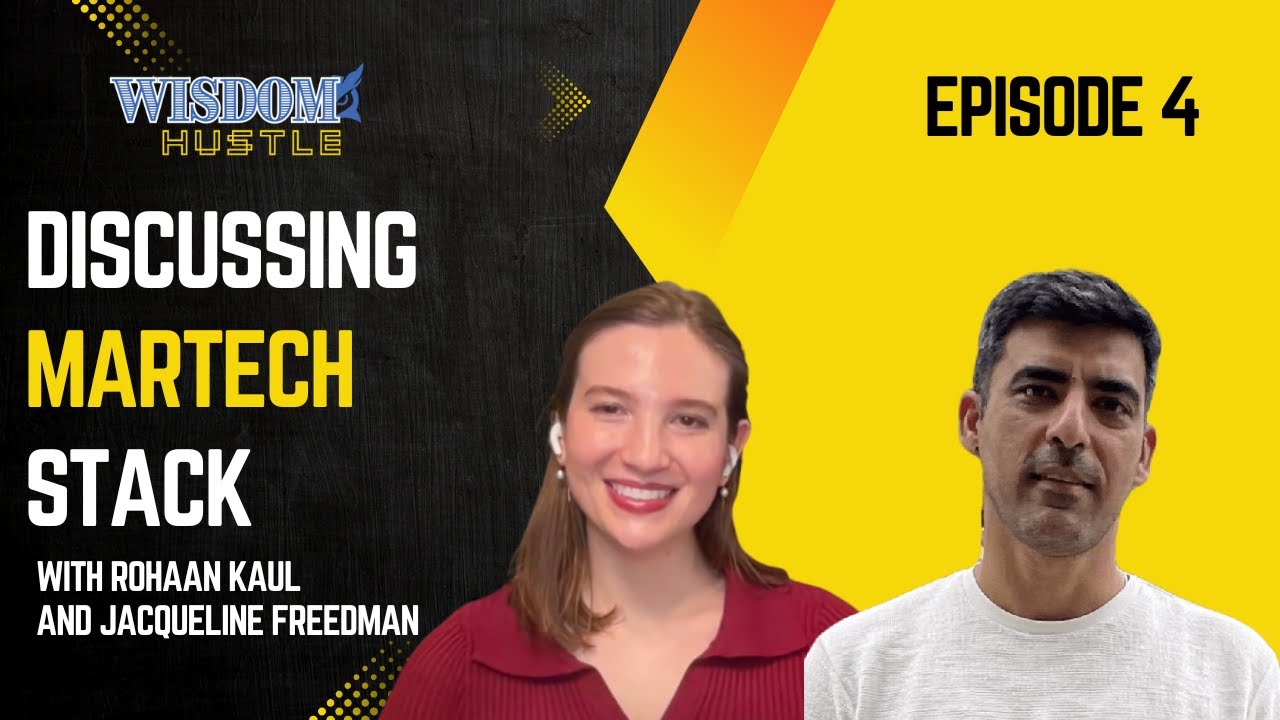
Explore practical insights on building a scalable martech stack and preparing businesses for the evolving Gen AI landscape. Discover real-world strategies to drive smarter marketing, sustainable growth, and innovation.
Hosted by
Rohaan Kaul (00:01.94)
Hello everyone, welcome to another edition of Martech 2025, our video series on building Martech tech stacks for 2025. Today on our panel, have Jacqueline Friedman, the CEO and founder of Monarch Advisory. Jacqueline has about 15 years of work experience in doing almost everything under the sun in marketing.
which is very interesting and I found it really interesting to hear that part of the conversation. She's previously worked with VWork and Grammarly. And the most important thing is she's a dog mom to two pups, which we like to hear at some point of time later on. She's also been associated with associations like Women in Email. She's also a community member in the Marketing Pros community.
So welcome Jacqueline. How are you today?
Jacqueline Freedman (01:01.321)
Thank you Rohan for having me. I appreciate the invitation. You know, it's a little dark out a little early, but all good.
Rohaan Kaul (01:03.464)
How are you surviving the thunderstorm?
Rohaan Kaul (01:10.928)
Alright, great. I read that you have a degree in art in media studies. how did you stumble upon into marketing? Because this is one, you know, whenever people who come from some other background, because I myself am a techie who stumbled upon into marketing. So, how I find these stories to be really interesting, how people get their aha moment that, marketing is my game.
Jacqueline Freedman (01:25.037)
Yeah.
Jacqueline Freedman (01:31.8)
All right. Right. Yeah.
Jacqueline Freedman (01:41.026)
I quite literally stumbled into it in two ways. One, I started working at a teeny tiny startup that has since been acquired doing one of everything. were two of us in the US and seven other people in London. So my first job was remote and learning sales, marketing, customer support, you name it. And in that process, to find out our office was in the WeWork headquarters in New York City. And I to learn, I kind of like what
WeWork is doing, this is 2014 and there were some job openings listed. I applied, it was the easiest interview process and then I just went two floors down. And I joined WeWork on the expansion team, which was a literal physical and digital go-to-market team launching new locations for WeWork. so went out to LA, opened up three locations out there, both physically on a construction site with punch lists and project managers to
hiring the team, doing the sales, doing all physical and digital marketing in a net new neighborhood, new community. And now alongside the story that is WeWork, it makes more sense, but after we completed our goals of hitting occupancy levels and achieving everything we wanted to on the West Coast, went back to New York to continue the job on new New York locations and instead had an 8 a.m. Monday morning meeting informing us our team no longer existed.
And either you get to find a job internally in the next week or you can leave the company. so fortunately, I had worked with the marketing team when I was on the West coast. They kind of gave me the keys to a different tools and platforms and said, just don't break things. And not only did I not break them, I got hired as a fifth marketing hire because they knew I could handle whatever they threw at me. And so I literally stumbled into it.
Rohaan Kaul (03:38.46)
is quite interesting. mean, yeah, I mean, interesting, mean, literally stumbling upon, right. So
Jacqueline Freedman (03:45.959)
Quietly. And forever grateful to that hiring manager for giving me a chance.
Rohaan Kaul (03:51.058)
Right, right. So tell me how, I mean from where you were like literally getting into marketing, how has been this transition into GTM and MaTeX? Like how's that come forth now?
Jacqueline Freedman (04:07.286)
Yeah, for me, it was seamless in that I was doing all of the above when I was just supposed to be doing email marketing. We needed someone to figure out what vendor for email platform we needed. We needed someone to relay and speak with our Salesforce architects and sales ops team. And so it just came part of the process and it wasn't until I left WeWork that I realized, I was doing operations this whole time, in addition to the softer skill of marketing. And so.
Instead, I decided to just double down and focus on that in my next roles until today.
Rohaan Kaul (04:44.34)
Interesting. So how is it like working with tech people?
Jacqueline Freedman (04:50.412)
It's my favorite. Be more specific. We'll kind of tech people. There's a lot of different types.
Rohaan Kaul (04:56.628)
I mean tech people as in especially the infrastructure guys and and probably the product development guys with whom a lot of times we work in terms of the martech stack integration
Jacqueline Freedman (05:11.074)
Yeah, I love my engineers so much because they make what I can't do possible and I make what they can't do possible. And so it's all about finding the right team members and teammates to understand and bridge the gap and translate amongst what you don't understand. And so while I can't fully build an API and connect it, I can give you the API key and explain why we need to do it now. And I just need someone to build.
Rohaan Kaul (05:28.009)
Mm-hmm.
Rohaan Kaul (05:39.027)
Right.
Jacqueline Freedman (05:41.33)
on the internal side to set it up. And so it's a very helpful relationship to really invest in. find engineers and at one point was an alternative title as Martech product manager too. So I find a lot of value in those roles just because you need the semi-technical MOPs, Martech individual, as well as the engineering and product side in addition to
Rohaan Kaul (05:49.492)
Mm-hmm.
Jacqueline Freedman (06:09.248)
the demand gen life cycle marketers as well. So you need to have someone who can traverse both sides. And that's the beauty of the role.
Rohaan Kaul (06:15.764)
Alright, okay, interesting. coming back to now the core, what we wanted to discuss today on the martech side of things. lot of technical advancements. I think so over a period of last 15 years, you've seen a lot of tech changes coming through. What is your outlook on what is going to happen in 2025 in terms of again, we are at
Jacqueline Freedman (06:35.883)
yeah.
Rohaan Kaul (06:44.776)
cusp of another tech revolution. mean, I've, I mean, back in the days, like I'm pretty sure from email marketing where we were, you know, doing the manual lists and everything to triggered emails to a lot of integrations, we've, we've come a long way over there. So we are on the cusp of another revolution. Yeah.
Jacqueline Freedman (06:48.377)
Or short.
Jacqueline Freedman (07:02.446)
Yes, thankfully. Yes, you're correct. Thankfully, we are on the cusp of that and the future is flexible and composable without a doubt. That is for any industry, any business model, we need flexibility, not only as the market trends, general economic situations, everything is changing as the world keeps becoming more
globally connected, things impact every region. And so with that, as it relates to your hiring as well, you have to be flexible. You have to know the tools that are next generation. plenty of tools that were sufficient, not even 10 years ago, less than 10 years ago are now legacy. They're no longer keeping up with the pace of any other of the next generation tools that are extremely important to bring into your tech stack, particularly on the marketing side.
Rohaan Kaul (07:58.868)
All right. So what do you think, I mean, in terms of the tech tools, I mean, of course, it's a no-brainer right now at this point of time that AI or Gen.AI is going to be a very important and critical component of your tech stacks building in the future, right? So where exactly do you think in terms of the tech stack designs and architecture, we're going to see changes or the application of?
these new technical advancements putting into place.
Jacqueline Freedman (08:33.215)
Yeah, I see a lot of changes coming on. How do we actually describe the individual and the next best action? There's nothing less inspiring for a customer or potential customer. If email is your only touch point, you want to be immersed in the world that they're in as well as target them where they want to be targeted. There's great platforms out there now that
Rohaan Kaul (08:55.358)
Great.
Jacqueline Freedman (08:58.22)
will tell you, hey, actually a push notification is the best way to get in contact with this individual, especially if you have a mobile app, especially in the consumer space. That is maybe the way they want to be treated. Mobile is, we've been saying about 10 years now, mobile is the future, but it's continually staying that way. think that's a, just a forever trend. It's now evergreen. Mobile will continue to be one of the places that you need to be investing in if it makes sense for your business.
And with that, it's really leveraging the AI tools saying, yes, actually, this SMS message is more valuable than an email for this individual and for these use cases. so doing your own analysis, but also seeing how AI can further enhance it and enable you is definitely the next thing to consider.
Rohaan Kaul (09:50.964)
Alright, so let's say for somebody who's planning to build out their tech stack, let's say, I mean, we're talking about consumer tech space in general, like companies that probably have a website or an app of their own and they're selling their products through a direct model using the digital channel, So companies operating in digital commerce or consumer tech space,
Jacqueline Freedman (10:05.294)
Thank
Rohaan Kaul (10:19.956)
looking to build out their stack in 2025 or probably they have an existing stack which they want to upgrade in 2025. So what would be your recommendations for that? What components should be there from category point of view? Or if they are making changes, what are the new things that they need to incorporate in their stack?
Jacqueline Freedman (10:27.598)
Thank
Yeah.
Jacqueline Freedman (10:43.244)
Yeah, it's a great question. And what I'm going to say applies to everyone, but it's something that will be the answer will be different for every company. So I strongly recommend doing a retrospective on and do a reflection on what has been working for your company. that's hopefully you have retrospectives. If you kind of have an agile work environment, if not, that's okay. You can look back on every campaign, every tool utilization.
How many folks are actually adopting it is the documentation you've created useful or the tools giving you the outcomes and the ROI you were anticipating. So really look and reflect on what's working as it exists and where you could invest more or alternatively identify, do you have redundancies? Is this tool actually, you had a promise of implementing it and achieving this ROI. Maybe it's not the tool for you. Maybe it's actually something you don't need.
And as each and every platform is coming up with new features, there's, the space is getting busy. There's nearly 15,000 Martech vendors in the space and that's probably not even everyone. so consolidation plays are definitely coming about in 2025 and beyond. There's already been a few acquisitions towards the end of 2024. And so real identifying your own redundancies, auditing what is and isn't working for you today and what can be improved upon.
Is there a new channel that the business school is planning to bring in? We'll say SMS. Well, do you want that new channel to be part of your existing tech stack? Does your current tech stack support it? so identifying, optimizing for singular sources of truth for, you know, Omni-Comm or excuse me, Omnichannel communications, such as a tool like iterable or braze or moengage or customer IO or UK with having modular design of
and attentive separately and or built on a different ESP. Things along those lines is things to consider. And at the same time, you'll ultimately be saving money either in the short term or the long term, one way or the other. And it'll also help energize your teams, thinking through what will continue to drive business impact and what you can further enhance in the year to come.
Rohaan Kaul (13:03.578)
Alright and in terms of somebody who's just building out a new stack like you know just starting out what what should they consider at this point of time you know the bare basics with which they need to start with.
Jacqueline Freedman (13:16.875)
Yeah, bare basics. If we're going off of consumer, did we say e-commerce? that's gonna be a blooper. Do we want to do e-commerce or do you want to do a different type?
Rohaan Kaul (13:25.577)
Yeah.
Yeah, no, that's that's fine. E-commerce or continue to take is fine.
Jacqueline Freedman (13:31.406)
Okay. Okay. I'm to do either one. Okay, so the question was, sorry, this gonna be a blooper reel, because I didn't have it written down or prepared, but all good. I got it.
Rohaan Kaul (13:38.929)
All
Okay, all right, no worries. Yeah, somebody's just starting out. Somebody's just starting out with the, you know, what would be the bare basics of building a martech stack.
Jacqueline Freedman (13:55.074)
Yeah. Great question. The bare basics, start in a Google sheet. See what you have. Are you making enough money to purchase a tool? Or are you still able to do things in Excel, hopefully in Google Sheets so it's shareable or something like that? See what do you actually need? Do you need a CRM? Do you need an e-commerce platform? Will Shopify suffice? Do you need to consider Salesforce?
Rohaan Kaul (13:59.582)
Mm-hmm.
Rohaan Kaul (14:15.945)
Mm-hmm.
Jacqueline Freedman (14:24.59)
or what makes the most sense for your business in the short term based off what you know, as well as what your planned and projected goals are. Particularly if you're VC funded, you know what your growth projections are and what your targets are. So you need to build not only for those goals, but beyond those goals too. So as an example, if you're looking to 2X sales in the next year and you don't have an e-commerce backend, let's start with Shopify. Let's get started. Let's use something that's
tried and true and proven and used across so many businesses, the backend is there. So as a result, if you have that as your backend, that gives you only one really excellent email platform option, and that's Klaviyo. Klaviyo is a great tool, especially if you have Shopify as your primary data source, and it's very customizable. And especially if you're new and you're a team of one, you're scrappy, it has everything you need right out of the box that you can
Rohaan Kaul (15:15.186)
Mm-hmm.
Jacqueline Freedman (15:23.694)
quickly customized to get started.
Rohaan Kaul (15:28.276)
Okay, cool, great. So anything from your experience that, know, on the personalization or hyper personalization side of things, any recommendations there or, mean, if you could share your experience of anything that you've implemented, because for years we've been always talking about, you know, personalization, especially in Martech, you know, the charter is always, okay, you know, we need to personalize the journey, we need to personalize the journey, right?
Jacqueline Freedman (15:50.519)
Yes.
Rohaan Kaul (15:56.38)
So if can share any experience of your where you've been able to achieve that because I've been trying to collect these stories around how people have been able to successfully do this part, one tricky or challenging part of marketing, which is the personalization.
Jacqueline Freedman (16:16.362)
In the consumer space, I think of two main points for personalization beyond first name, last name, most recent purchase, which at this point are standards and not personalization like some people like to tout. It is meeting the customer where they want to be met. So hard getting back to what we previously talked about the next best action. What is the next correct source of information? What channel do they want to receive it in? So meet people where they want to be met.
Rohaan Kaul (16:30.014)
Right. Right.
Jacqueline Freedman (16:46.872)
But also hyper-personalizing, filtering, and editing your triggers in the lifecycle space based off of your customers' actions. Not just purchase or browsing a certain site and doing an abandoned cart. Those at this point are standard practices. If you're going to have a recommendation engine, make it personal. Make it make sense. Even the Shopify out of the box. It's not perfect if you have your taxonomy
in such a way that you have multiple products written more than once as an example, which then leads me to my final point for personalization. It's based on the data you have. So you have to focus on data integrity, not only the accuracy, but the swiftness. And so this is where further. Composability tools come into play. So composable CDPs like high touch, like census. So you're actually able to see exactly what's happening and trigger.
Rohaan Kaul (17:21.64)
Mm-hmm.
Jacqueline Freedman (17:46.464)
in real time or close enough to real time. Personally, they should on your website, personalization and emails, all related to what the user is driving. There's nothing worse than receiving a personalized email that's not actually with your own data. think Spotify wrapped this 2024 this past year learned the lesson of not so much focusing on the individual in the same capacity as they used to.
Rohaan Kaul (18:02.206)
Right.
Rohaan Kaul (18:13.914)
Right, interesting. coming back to what you started off at the start of this podcast about flexibility element of it, Especially given the fact that this is going to be probably a year, as we know, it's
Jacqueline Freedman (18:25.731)
Yes.
Rohaan Kaul (18:35.058)
technology, new technology coming in, right. We'll be trying and experimenting with a lot of things, right. Now in terms of that, how do you actually get scalability into your tech stack, right. I mean, because a lot of times, you know, I know this challenge that comes is we have something called a technical debt, right. You know, we build, we get tools, then they're
Jacqueline Freedman (19:00.691)
Mm-hmm.
Rohaan Kaul (19:04.772)
not utilized or they are integrated because there's been so much effort with the integration part of it, they just keep on lying as it is over there. So considering this, how do we bring in the scalability and flexibility component of it without adversely impacting the expenditure or how do you scale this, how do you make this work in 2025?
Jacqueline Freedman (19:29.809)
Yeah, I love this question because scalability is what I've cut my teeth on and learned everything along the way. So one, you need to identify.
Rohaan Kaul (19:36.905)
Mm-hmm.
Jacqueline Freedman (19:39.662)
what you're actually projected to do real and, and what you want and also want to achieve. And not just in the next year, you need to have horizon lines. And this is you have to talk to your leadership. What do we plan to do in the next two years, three years, five years? What is the company wide mission in the next 10 years, whether it's actual targets or what is the greater goal? So a great example, when I worked at Grammarly, there are
Rohaan Kaul (19:51.06)
Mm-hmm.
Rohaan Kaul (19:55.934)
Mm-hmm.
Jacqueline Freedman (20:09.312)
over a billion English speaking individuals. So that was always a high level number to know that's the maximum capacity, least, you know, as of a year ago, maximum capacity of potential audience. So knowing that that could become the greater audience over the next five, 10, 20 years, notwithstanding trends, market changes, you name it, we have to be able to think that far ahead. So look at where you're at now and what you could project towards.
And of course, consider the addressable market, but also the realistic addressable market. So we weren't actually planning for 1 billion, but we wanted to ensure we could find partners that would make sense for it. So as a result, you have to make sure not only you stress test companies you decide to look at, but also would you be their biggest customer? And that's usually a problem. If you're going to be their biggest customer, you're going to be their guinea pig. So you need to...
And if you're evaluating these tools, you've got to really talk through, to talk to current customers, previous customers, customers who migrated away or migrated from, you need to understand what pain points they experienced to ensure scalability. Something I do out of a habit is I subscribe to every status of every major martech vendor. So I'm consistently and constantly aware of who is working well, who isn't every company.
Rohaan Kaul (21:29.704)
Mm-hmm.
Jacqueline Freedman (21:36.15)
It has downed downtime and so it's not an individual thing, but it's helpful to see general trends of who's having scheduled maintenance versus unplanned UI or just things not loading, you name it. And so you also have to remember you have go to the sources too, not just the ESPs as a great example. So ESPs, ultimately they're the front end version of a backend.
Rohaan Kaul (21:49.14)
Hmm.
Jacqueline Freedman (22:04.398)
system like Mailgun or SendGrid. So you need to also subscribe to the source material because if the source is having an issue, ultimately your front end version is going to have an issue as well. And so it's also helpful to know not so much in the blame game, but understanding where the scale is breaking or what happened. And also that's where, in my opinion, whenever you're looking at vendors, a remediation plan and explanation is super valuable and super important. So how would
Rohaan Kaul (22:17.523)
Right.
Jacqueline Freedman (22:34.408)
respond if you were a customer, how quickly would they respond, through what channels and means. And so that's where I see scalability coming from is it's twofold internal planning, but also stress testing and pressure testing, what other tools can do.
Rohaan Kaul (22:36.339)
Right.
Rohaan Kaul (22:50.278)
Okay and the flexibility component of it how do we get that?
Jacqueline Freedman (22:55.082)
Yeah. For me, flexibility is how easy is it to implement new things? Are they having new features coming on board? If we decide we want to re-architect something, does that mean we have to do it in a sandbox and hope it works? Or does it mean we get the opportunity to try it on a sandbox fully and then completely replace what we had? And so do they have the ability for you to test and be flexible or
Rohaan Kaul (23:13.064)
Mm-hmm.
Jacqueline Freedman (23:24.246)
Is it going to break everything? And so sometimes that's where certain tools and their rigidity and lack of flexibility of customization is both a perk or a con, depending on how advanced you want to get into a situation.
Rohaan Kaul (23:38.576)
Yeah, I actually agree with you because I've seen that differentiation, you know, when it comes to enterprise tools and tools that are made for the, you know, the startup and the midsize segment that, know, usually the bigger, those that were built for enterprise usually had a sandbox component. And usually, you know, the ones that were built for, you know, audiences, which are like more startupy or still, you know,
Jacqueline Freedman (23:57.804)
Yes.
Rohaan Kaul (24:07.772)
small to mid-size segment. They typically did not have the sandbox component part of it.
Jacqueline Freedman (24:12.504)
Yeah, exactly. And while. good.
Rohaan Kaul (24:19.09)
Yeah. All right. So sorry, go ahead.
Jacqueline Freedman (24:20.616)
I was like, nevermind. No, no, I would, I didn't know if you would want it. I have one comment on the like the B2B side. I could mention it's a little bit of a hot take if you want, or we can just, I'll say like in that same vein, this is where companies recognize where they are in the SMB mid-market enterprise ear of their audience size, what their needs are and custom customization options. So for example, if you use
Rohaan Kaul (24:31.412)
Shush? No, no, no, go ahead.
Jacqueline Freedman (24:50.57)
SFDC Salesforce CRM up against HubSpot. They're both wildly successful tools, but they serve very different audiences. One is fully customizable. However, you need a full-time architect and admin at minimum to maintain. And that's an upfront investment, but you can make Salesforce do anything you want. For this HubSpot out of the box, it works pretty darn well, especially if you're a small scrappy team. But you, if you want to start customizing.
Rohaan Kaul (25:10.398)
Great.
Rohaan Kaul (25:17.351)
Right.
Jacqueline Freedman (25:20.498)
well beyond what it's originally intended for, it gets more difficult. But also you start reaching limits where it becomes overpriced for what it is. And so all of these things have to do with scale and just depends on short long-term growth, but also what skill set do you have at your company right now and plan to hire for. So if you're looking for fractional help, that's one thing. Or if you only want to have in-house and you
Rohaan Kaul (25:25.726)
Mm-hmm.
Jacqueline Freedman (25:48.96)
only have the budget for one or two people for each side, that will also reflect how you scale and the tools you should choose as a result. Because you don't want to throw someone into the deep end because they'll just they'll fail if they're not proficient.
Rohaan Kaul (25:55.697)
Right.
Rohaan Kaul (25:59.772)
Okay, true. mean, I was actually, that was one of the references I had in mind because I actually worked both on Marketo and HubSpot. And that was one of the differences that we had, like, you know, the sandbox environment, which was there and not there. Right. Cool. That's great. That was a
Jacqueline Freedman (26:11.682)
Nice. Yeah.
yeah.
Rohaan Kaul (26:23.486)
great insight. mean, I can relate with a lot of things. So in terms of skills, like, you know, what are the new skills do you think that teams will need in 2025? Like new skills that they need to bring in to their teams? What would those be?
Jacqueline Freedman (26:39.118)
Yeah. Sorry, my dogs are making weird noises. Hopefully you weren't hearing them. In terms of skills for 2025, some of them in my eyes are evergreen. It's curiosity. It's willingness to Google or chat GPT, trying to find solutions until you have a good enough idea of how to navigate something or propose something. It's having mentors, having a community to reach out to. And so that's an innate.
skill anyone can learn, but actually acting upon it, not as easy if it's, if it's not intuitive to yourself, but that really something we can all learn and we all should be learning is how do we communicate with Gemini, Claude, with open AI? Not so much that it, you know, we're at the first inning of the first base, the first inning of what AI is going to bring to the table.
Rohaan Kaul (27:35.923)
Right.
Jacqueline Freedman (27:36.28)
So we need to get familiar with it because your job's not going to be replaced, but your job will be replaced by someone who knows how to use AI in your job. And so we should all be leveraging the skills, the tools, learning how to speak with them, learning how to enhance exactly what you need. And also ridding of some of the menial tasks that can be automated with just a little bit of AI help. It's only going to continue to transform.
Rohaan Kaul (28:03.7)
All right, cool. think so. Great. mean, great, great way to actually end the session. think so we are close to the end of time also for this. So any message that you have for the marketing community for the coming year? I mean, since we are gearing up for end of the year and the whole purpose of this series was basically to prepare people for 2025. Your message to the marketing community.
Jacqueline Freedman (28:29.933)
Yeah. Yeah. While we've been mainly focused on platforms and planning, something we didn't fully get to emphasize is just as it is important to find the right tool and plan as well as you can, plus or minus things changing of your OKRs, your people are your next most, or the most important, but just as equally as important as all three.
You have to have them all in unison. If you don't invest in your people or invest in the interviewing process to find the right candidate, you've already put yourself behind. so really finding someone or teams of people, whether it's a fractional individual to get you started or full time in-house team, your people will make the difference and make or break a platform being implemented and used properly or implemented and just left behind.
Rohaan Kaul (29:04.062)
Right.
Jacqueline Freedman (29:23.926)
and not maintained. So the people are just as important, even though we've been focusing on all the other trends and that if it didn't up itself, it's a whole other podcast of how to find the right people and making sure they're what you're looking for. so non-biased hiring, all of the above are really important to a successful 2025, but many years to come as well as a general, you know, successful company. So the people are the most important.
Rohaan Kaul (29:45.182)
Mm-hmm. Right.
Rohaan Kaul (29:52.53)
Right or you can have use our platform to hire the people instantly
Jacqueline Freedman (29:57.664)
Yeah, right back at you, same here. Yes, same here. I was trying to make it a casual one on my side, but I'll make it blatant now.
Rohaan Kaul (29:59.604)
shameless plug but I have to do that as the founder of the company does the number one thing keep on selling yeah
Rohaan Kaul (30:10.664)
No!
All right, cool. All right, Jacqueline, it was wonderful having you on our show today. I mean, this was a lot of information. think so this is, you know, from the series that we're doing, this was a little bit of a diverse point of view and really enjoyed talking to you today.
Jacqueline Freedman (30:28.462)
Yeah.
Rohaan Kaul (30:31.796)
As the new year is coming, as I said, this is prepping up the marketers for new year. I wish you and your family a very happy new year in advance. I hope you have a very successful 2025 with Monarch advisory. I know you also started up really this year. I wish you lot of loads of success in the coming year too.
Jacqueline Freedman (30:56.094)
Yes, thank you so much for having me and same to you and the entire ZAP Ops team. Thank you so much.
Rohaan Kaul (31:00.436)
All right. All right. Thank you. Thanks a lot.