Episode 14
6 minutes Why Founders Fail to See Their Product Like Customers Do!
Rohaan Kaul, Founder, Zavops
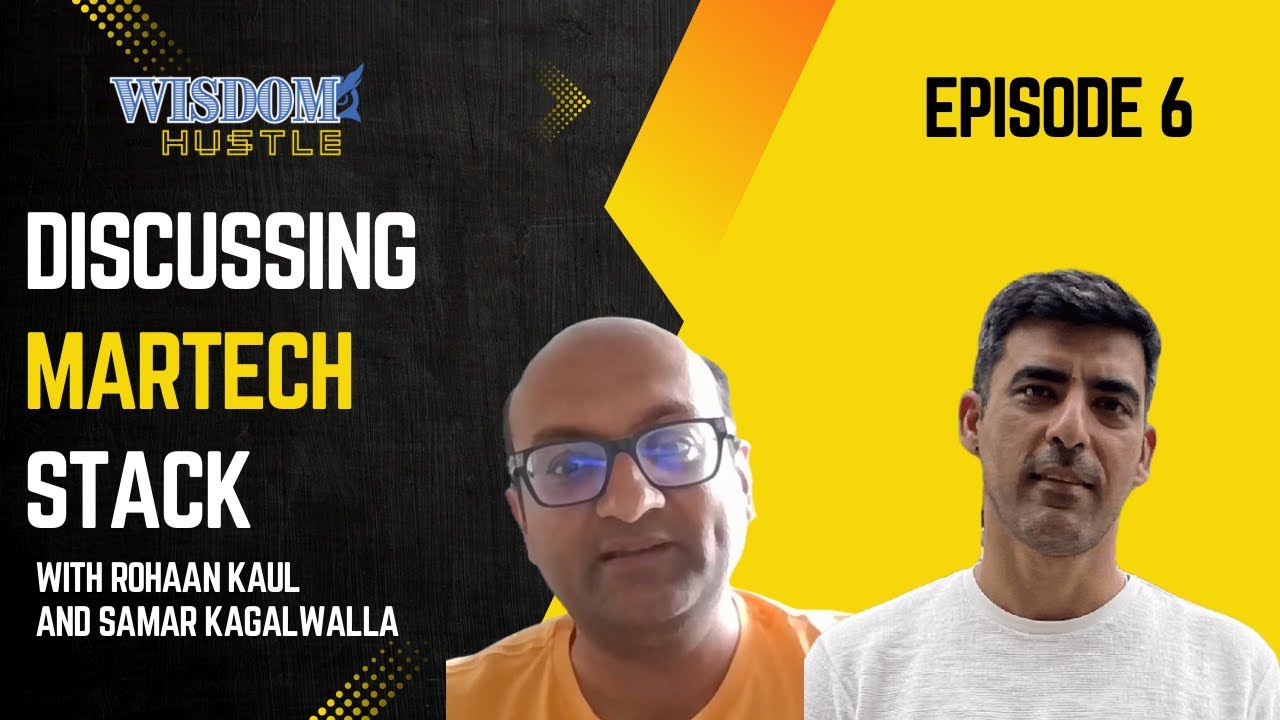
Explore how AI is reshaping compliance in regulated industries. Discover key insights into banking, fintech, and the evolving B2B2C landscape.
Hosted by
Rohaan Kaul (00:01.404)
Hello everyone. Good afternoon and welcome to another episode of wisdom over hustle and today we are going to continue our discussion on Martek in 2025 and today, you know from marketers and technologists. have somebody who's from a marketing background, but he works in a very specific industry, which is slightly has an impact of compliance on it. So I would like to.
introduce summer kagal wala my guest today who is a CMO and heads the marketing at on surety and cover a summer has a huge experience in banking and finance industry. He has in the past work with a you small finance bank. Yes, Bank RBL and HDFC in different roles leading marketing and communications over there, right personally, but I know summer as somebody who is
a very enthusiastic community builder who loves to contribute to community and that is probably one of the reasons that I have connected with summer because of both of our interests on connecting with the community and there's another underlying reason. We actually have strong connections with Gujarat and I think so that that also is a common thread with our love for some of the Gujarati snacks or what you call for Sun, right?
Samar (01:17.358)
Good luck.
Samar (01:25.198)
Everything starts over food and demography in India.
Rohaan Kaul (01:28.738)
Right, true, true. So welcome, Samar. How are you?
Samar (01:31.63)
Thanks. Thanks. Thanks, Ron. Firstly, absolutely awesome to be here. I love the title with the more awesome. I mean, it's, can have a podcast on it. someday. Yeah. And I can assure you a good panel who can, who should be part of it. can have an interesting conversation. But great, great to be here. And I'm amazing to have a chat today. Lovely topic.
Rohaan Kaul (01:43.656)
Sure, sure. That's more of a coffee conversation.
Rohaan Kaul (01:56.466)
Shove.
Rohaan Kaul (01:59.848)
Welcome, welcome. Thank you. Thank you for sparing your time. For everybody who's going to probably watch it later, let me tell you today is a weekend and we are shooting this weekend on an afternoon. And that's the reason why for the first time you see I'm not wearing a jacket because from cold winters.
Samar (02:10.562)
Yeah.
Samar (02:15.156)
Same here. We are delivering wisdom over a hustling Saturday. Are you making me hustle on a Saturday or some wisdom?
Rohaan Kaul (02:21.392)
Right, right. Right. True, true that. Okay. So, summer before I jump into the, you know, more questions around, you know, the work part of it. I think the most important question is how, how's the journey from Mumbai to Bangalore? What brought you here? I mean, of course that's the job part of it, but how's, how's been that journey from, from Mumbai to Bangalore? Like, you know, two cities almost
similar when it comes to a lot of people coming from different parts to make a living over here. But the transition, the journey, how was it?
Samar (03:00.91)
Well, you know, I was like you said, I'm on I wasn't part of India's most hustling city. Correct. And from there, you know, I transitioned to a city, you know, where there's a lot of balance and peace. So that was a good, good change. Correct. Do I regret a little bit of hustle? Because naturally, you know, you have that in your blood for about 35, 40 years. So difficult to miss that. But I really explored the new me in city of Bangalore.
Rohaan Kaul (03:17.778)
Mm-hmm.
Samar (03:30.966)
particularly when it came to exploring newer things of life, including work. Let me put it that way. Because moving from a conventional BFSS segment to a startup itself was a big change. And I think it was only because of a city like Bangalore that you could sustain and explore. Because the city has something which gives you a balance. If I had to become a Mumbai-Karin Bangalore, it would be very difficult.
Rohaan Kaul (03:38.536)
Mm-hmm.
Samar (03:59.17)
contrasting cultures, contrasting way of working. So I like the best of both. Yes, I do crib over, you know, this over some dinners with friends and all, but that's just for little fun and laugh with a of Bangaloreites around. So besides that, all good. And I like the city, correct. But I miss the hustle.
Rohaan Kaul (04:21.138)
Mm-hmm.
Right. Cool. So I mean, as I told you, you know, when we met personally, I made the switch from and the back to Bangalore. So quintessentially like, you know, at times I'm like, yeah, the traffic and everything we crib about it. But overall, it's I mean, the city is amazing.
Samar (04:38.375)
Yeah.
So, infrastructureally, would not rate Bangalore so high at this point. Even though Bombay is not so great, but the amount of population that it holds in a city and the kind of infrastructure it's able to manage. Correct. I think it's far superior than what Bangalore is able to do with this kind of population vehicles. So, if I leave that debate aside, I think it's a great balance.
Rohaan Kaul (04:57.99)
Right.
Rohaan Kaul (05:02.312)
True. All right, cool. So let's jump into the work part of it. Like both of us have been outsiders and I love the part that how the city has accepted us and you without a doubt, that's been the best part of the city and that makes it very difficult for me to leave now. okay, coming to the work part of it. See, you worked in compliance.
Samar (05:06.67)
Thank you.
Samar (05:12.096)
Absolutely, without doubt.
Rohaan Kaul (05:29.51)
heavy environment for a pretty long time. think so with the conventional banking segment, it's been more as compared to probably in the FinTech sector of it, right? Could you explain the difference like in your current setup, which is at an on-shority? Maybe you could give people a little bit of background about on-shority that would be great. And then in terms of compliance, how different it is for the FinTechs in general.
Samar (05:53.357)
and
Samar (05:57.23)
Okay, before I come to Onchority or let me start with that, Onchority is an employee healthcare platform, We started off focusing on SMEs and startups to take care of the employee benefits for smaller companies. We are the only company that does this on a monthly subscription basis. So that's where our tech stack is built at. When we almost run billing like a Vodafone or a Airtel would be doing for their subscribers.
for a healthcare kind of a product which was unheard in this kind of industry. Having said that, when I look at my past 15, 17, 16 years in banks versus the new setup that's on charity, banks dealt with lot more product categories and each product category had a regulator besides RBI being the core regulator for banks.
Rohaan Kaul (06:50.568)
Mm-hmm.
Good night.
Samar (06:54.254)
The compliance was much more stringent and much more complex than what currently at OnshoreD we would be doing. OnshoreD has to be completely compliant, but that's more at a business and a product level. At communication or at a marketing level, we are just taking nascent steps. So we do the basic checks right. PII data has sensitive data has be used. If those data checks are in place, broadly we are compliant.
Correct? Because we are there from our style. Our stack is very simple, very lean. Correct? Unlike a bank. Correct? Where we like on an average there are about 60 to 65 product lines in a bank. Correct? I myself was looking into about 20 or product lines from the marketing perspective. So it's much, it has to be automated. Correct? There is no doubt on it. Correct? Every process, every martech
Rohaan Kaul (07:41.788)
Mm-hmm. Right.
Samar (07:50.61)
A tool that you onboard has to be legally verified. And the most critical part is how the sensitive data is going to be utilized. Because bank has so much of data. mean, if you say in typical Bombay language, you have be extremely, extremely careful on how your sensitive data gets...
Rohaan Kaul (08:09.522)
Right.
Samar (08:18.286)
you know, utilized from different functions like credit might require marketing should have edited access, correct? And that's how the systems are built. Underline data remains the same from the customer perspective. So every tool that's working with every view needs to pick the right kind of data basis, the compliance guideline. And that was the biggest challenge. It's very easy for me to sit here and say that, you know, we have so many cases that we've come to know that, you know,
someone else's account balance SMS has come to us. Correct. Someone else's, or, you know, misrepresentation of some emails have come to us. bulk email have been shot without approval. Some wrong data has been fetched. Correct. So these kind of things keep happening, but at the tool level, there are definitely checks put in place. Correct. But beyond every tool, there's a human.
So, you you have to account for a manual error somewhere. Correct. But coming to on surety, we are evolving. We are evolving. We are much more compliant than what we were four years back. Correct. Right from the data storage to, you know, the data usage to, you know, let's just give a second. think there's a tight way.
Rohaan Kaul (09:25.212)
Mm-hmm.
Rohaan Kaul (09:29.32)
Mm-hmm.
Rohaan Kaul (09:45.158)
Another Bangalore thing, Bangalore specific thing. That, that...
Samar (09:49.518)
Sorry, they are practicing for the air show and I am right behind the hell strip. it's little...
Rohaan Kaul (09:57.478)
Yes, that sometimes on the calls when you have something like this that tells you where that person lives in Bangalore.
Samar (10:06.252)
No, absolutely. So coming back to, you know, on surety, we currently have a very lean system. We have clever tab that we use for all our post-event triggers, you know, and post-event communication. kept it very simple on the backend. Correct. While on my, my front end CRM is lead square. Correct. Where all my acquisition led, you know, journeys and events get triggered from. Yes, we have some tools which we use from the communication perspective, but
that's all merging into one of these two big stack that we have. So we right now keep it very lean because we also need those level of processes and teams to manage it. And because we ourselves are very structured, very thinly, we do not want to expose ourselves to too many tools because every tool that we add or we decide to add has its own implications on the data flow.
Rohaan Kaul (10:43.953)
Alright.
Rohaan Kaul (11:03.25)
Mm-hmm.
Samar (11:05.93)
And we are very, very keenly understanding the DPP bill because, you know, every platform that's going to come, you know, between the customer and the manufacturer, correct. We'll have its own reprogations on the storage of data, erosion of data, correct. Usage of data, consents. Consents is a big factor for us as well. Correct. We have built our systems in place, but we keep evolving because the regulations are evolving. So these are all the aspects that.
Rohaan Kaul (11:06.108)
Mm-hmm.
Rohaan Kaul (11:11.89)
Right.
Rohaan Kaul (11:21.416)
Right.
Rohaan Kaul (11:27.112)
Mm-hmm.
Rohaan Kaul (11:32.476)
Mm-hmm.
Samar (11:34.466)
we have started to look at on-surety and because we have no baggage, we are able to develop this ground up. Now imagine something like a bank which has its own structure in place over the years and when they will have to start modifying these processes to meet the law, it's going to be one of the biggest challenges for larger corporates.
Rohaan Kaul (11:46.952)
Hmm?
Rohaan Kaul (11:55.26)
Right. Cool. I understand. I actually have been on that site once so I was working with a friend tech company back in the past and not the DPDPS but something similar. were right in the midst of when GDPR got launched like, know, I remember this was around May or June and we had like not as extensive like a bank would have for years altogether. I mean, we're relatively a startup. So it was just
Samar (11:59.593)
I am so
Samar (12:11.438)
Go on.
Rohaan Kaul (12:22.96)
two years of data, but we still had around data points for around 2 million people like data of about 2 million people that we'd and now we have to go into a process where you know GDP are mandates not only the consent parted, but there are various processes around it and you know, we basically I mean thankfully again like we were basically as cut up. So, you know things can be really lean but I can always I mean, I know with the banks and
Samar (12:44.683)
I am.
Rohaan Kaul (12:52.508)
more traditional system, it's really, really complex. It's like, you know, there's a book called Elephants Can't Dance. So I sometimes related with that.
Samar (12:59.438)
Yeah, I that's why I don't compare both the ecosystem. Very, very differently structured. Correct. Their RBI is super, super vigilant on stuff. Not that other regulators are not. Correct. But other regulators currently have to deal with one line of business while insurance also has the implication on banks. Correct. Likewise, lending has implication on banks, mutual funders implication on banks.
Rohaan Kaul (13:14.472)
Hmm?
Samar (13:26.872)
Correct. So all of these have their own regulators as well as RBI to deal with. Correct. So that becomes a little tricky one for us. Like for example, right from a customer segmentation that we do, correct. We have to be very careful that by no way or no chance, for example, I can, I do not segment basis the claims because imagine if the claim data goes to any third party, correct. It's suicidal. It's a personal information. Correct. And that's where
Rohaan Kaul (13:30.354)
Mm-hmm. Right. Correct.
Rohaan Kaul (13:46.94)
Right.
Mm-hmm.
Rohaan Kaul (13:53.48)
Great.
Samar (13:55.896)
sensitivity in the team seem to be built. Right. Training has to happen. So it's, it has a lot of implications as well. Besides just getting the tool in place. Correct. Because, empathy towards data is going to be very, very important. is important for every user of the tool to empathize with the data they have in hand and understand what's going to happen with it. Correct. It's not empathizing with the customer anymore. It is more about the data.
Rohaan Kaul (14:05.768)
Right.
Rohaan Kaul (14:20.092)
late.
Samar (14:24.526)
the customers trusted you with the might as well empathize with it.
Rohaan Kaul (14:27.176)
Mm.
Right, true, I agree. Now, some interesting.
Samar (14:32.014)
Hold on, hold on. Let's apply it. Let's apply it. Sorry. I know you will have lot of edits on this.
Rohaan Kaul (14:37.329)
No video.
Rohaan Kaul (14:42.394)
All right, maybe I'll keep some of them to know, you know to let people have a little bit of fun. Right through that. Okay summer as far as I remember, you know in one of our earlier conversations, we had mentioned that on surety has both b2b model and b2c model and I think so this is a b2b to see model, right? Do you right? So do you have text acts for each of these models as separate right?
Samar (14:45.454)
It was real and not age under 10.
Samar (15:01.208)
Correct. It is a B2B2C model.
Rohaan Kaul (15:10.918)
And if yes, mean, is there any underlying reason for that?
Samar (15:16.122)
See what happens is because it's a B2B2C model understand my business. My initial customer is a B2B. My eventual user is B2C. So my entire service stack is B2B2C compliant and my entire acquisition stack is a B2B compliant. Correct. So that's the basic difference between if I do understand, makes a layman understand in a B2B2C thing, for example claims.
Rohaan Kaul (15:21.149)
Mm-hmm.
Rohaan Kaul (15:27.868)
Right.
Rohaan Kaul (15:33.319)
Right.
Samar (15:45.102)
My claim stack has to be a B2B2C experiential than a B2B experiential. But my billing has to be more B2B experiential than B2B2C experiential. So that's how we differentiated our teams. That's how our pods are differentiated. That's how our overall approach are differentiated. Correct? That if I'm looking into the B2B space of experience, what are the like I do, do dashboards. Correct? Now dashboard is a classic case of B2B. Correct? So my entire
Rohaan Kaul (15:49.81)
Right. Okay.
Rohaan Kaul (15:55.432)
Right.
Samar (16:13.154)
team has to think like a business utilizing my feature versus a member utilizing a feature. But as soon as I come to an app, the entire management has to think like a D2C company. Correct? So definitely my stacks, my, my, my, you know, the data structure, everything gets differentiated basis of what part of the journey I'm looking into.
Rohaan Kaul (16:19.816)
Mm-hmm. Right.
Rohaan Kaul (16:39.26)
Right. That's pretty interesting. I'm All right, interesting. I'm getting jealous now. Okay. Yeah, I know. So so like you said, you know, I think so with the level of compliance of the stacks do I mean the joys of stacks do get impacted right if I'm to name like three four factors, this is which usually
Samar (16:41.154)
My marketing also gets segregated that way.
Samar (16:46.734)
Yeah, a lot to do.
Rohaan Kaul (17:06.28)
in regulated industries, the martek choices are influenced. What are those four or five factors? I mean, because a lot of lot of things is, I mean, our audience is basically also people who are startups and who have built a product for martek like, know, and they aspire to sell it to the banks because I think the financial industry has a major, major impact or use cases for AI given the volume that they serve. Right. So what do you, what do you think like from a four or five top factors that influence the bank when it comes to, you know,
Banks more regulated industries that I'm talking about the four five factors on the basis of which a marketer or a head who supposed to make investments into Martek would take into consideration while making the making a purchase.
Samar (17:49.038)
So I'll answer this with one step, I'll take one step behind here. So I'll not look at a marketer's lens because after a point, know, a of decision makers from different views get involved in a proper stack. Correct? For example, when it's a marketing stack or a customer experience stack, marketing and make a choice. I like this because of these things, but there's a CFO involved, there's a CBO involved, there's a COO involved, depending on what your structure of the company is. Correct? So firstly, you should, as a, as a martech company,
Rohaan Kaul (18:07.432)
Right.
Samar (18:17.548)
you should have a relevant case study for an organization and not for a BU. Correct? Because the day you have it only for the BU, you know, it becomes difficult for you to convince different stakeholders who might be involved and today customers or the organizations are not like departmentalized. Across BU's people are involved in multiple aspects of working and hence they also become part of your decision-making ecosystem. Correct? So that's my first thing. Secondly, trust is the most important factor.
Rohaan Kaul (18:21.788)
Okay.
Rohaan Kaul (18:34.096)
Late.
Rohaan Kaul (18:44.104)
Mm-hmm.
Samar (18:47.138)
Like I said, every FinTech would be dealing with PIA. Without PIA, they cannot run their business because they're dealing with someone's money. So the most basic PIA would be Pankad, Aadhar card, which is all information. So it is extremely important to inform them where the data is going to store, where your servers are, what sort of logs they can access, how quickly can they understand, implement processes. Implementation of processes is going to be the third
Rohaan Kaul (18:47.4)
Mm-hmm.
Rohaan Kaul (18:52.136)
Right. Right.
Right.
Rohaan Kaul (19:09.597)
Mm-hmm.
Samar (19:16.27)
most important factor because it is getting so, you know, of, of, of, of, of, of, of, of, of, of, of, of,
That's why sometimes the marketers like working with smaller companies versus a larger enterprise. Classic reason is that boss who change karna hai, new process add karna hai. Correct. It does not take too much of time. And actually all of this has implication of price. Correct. So I'm not even going there because India is a price sensitive market, whether we like it or not like it. Correct. So eventually you have to compete on price. But if I keep price as a common factor,
Rohaan Kaul (19:49.05)
Mm-hmm. Mm-hmm.
Rohaan Kaul (19:57.512)
Great.
Mm-hmm. Correct.
Rohaan Kaul (20:04.996)
That's true.
Samar (20:12.706)
Then these are some of these two, three factors, I feel that a marketer currently is using. Correct? Because previously marketer used to figure out or marketer is to consider when I was in like HDFC and Yes Bank, what's the level of personalization you can do? What's the level of, you know, multimodal communications you can do, but you're, think in today's world, that's all given. I don't think that we haven't debating the 360 degree communication or tool should have, you know, ability to do it. But now.
What we are looking at is the security aspect, agility aspect. The kind of customers you are servicing currently, aspect is extremely relevant. Your understanding of business as a whole aspect is very critical. And the founders of these martech companies will have to invest time in
Rohaan Kaul (20:52.732)
Hmm. Hmm.
Samar (21:08.0)
making their tool relevant for an organization versus a BU because with AI also coming in, correct? And lot of marketers putting AI as one of their specialized features. AI has an implication, which is beyond just one BU, correct? And with which, which their tool can support. So it's important for someone to understand the business and the stakeholders very well. I feel that gets missing when I interact with some of the agencies these days, where they are so, they get so
Rohaan Kaul (21:22.834)
Right.
Rohaan Kaul (21:29.959)
Right.
Rohaan Kaul (21:34.792)
Mm-hmm.
Samar (21:37.39)
one sided that because I'm a marketer, I should be told only about the marketing side. Because I'm not a customer experience head, I should not know what's happening in customer experience. That needs to change.
Rohaan Kaul (21:42.373)
Night.
Right. Okay. You are selling to a business rather than to an individual.
Samar (21:52.16)
Yeah, yes, you're solving a business problem for a consumer, right? Not a marketing, not an experience, not a data problem for a consumer.
Rohaan Kaul (21:59.654)
Right. I mean, coming on this now, similarly, like we're talking more about, you know, the sales part of it. But in terms of the products that are available in the do you see that there are any gaps that, you know, specifically for your industry or industries that are into, you know, that are compliant heavy. Do you see there are any gaps in the market that the current tools have not been able to fulfill and how is there a scope or potential for somebody to, know,
maybe solve that problem. Is there anything specific that you're seeing?
Samar (22:30.892)
Yeah, honestly, I've worked with Adobe. I have worked with HubSpot, for example. I have worked with LeadSquare and I have also seen a of local players who have presented to me a things. Three I have worked hands on. We also used to work with Netcore and so a of tech tools. Every tech tool has a gap because they cannot be pleasing every customer fully. What's happening is some of the conventional players.
Rohaan Kaul (22:34.888)
Mm-hmm.
Rohaan Kaul (22:44.539)
Mm-hmm. Mm-hmm.
Rohaan Kaul (22:56.614)
Right.
Samar (23:00.91)
I don't want name them. Have got little, you know, little easy on, you know, the new developments that are happening. Correct? While the newer players again, because they have no baggage, they're coming with the right kind of expectation meeting products at the first go. Correct? The larger Matic companies or the older Matic companies are still working on that thing that basic...
Rohaan Kaul (23:21.348)
Mm-hmm. All right. Wow.
Samar (23:30.712)
then we will charge and we will develop this instead of preempting that this is now required. You charge which is fair but my time also cost me. I cannot be spending time and paying money. This is one big aspect that first aspect that the older or the conventional businesses which are into MaTec who are entering into the newer domains
Rohaan Kaul (23:41.042)
Right.
Samar (24:00.76)
can get a little more preempting in their offerings and solutioning rather than waiting for the customer to come back and giving basic like I don't want to say that someone did not have a basic Facebook and a Google connector and we are struggling for three months. Correct? I mean that's stupid. I mean, you know, I can't be struggling for such things.
Rohaan Kaul (24:21.81)
right? Understandable. know I...
Samar (24:24.078)
Correct? mean, is... I mean, I don't want to name them, you know them whom I'm talking to, but... I did all my calls that I had to do with people who shouldn't be calling for such things. Correct? But, leaving that apart, second part that I feel, Rohan, is I don't know if anyone's touched this before, but I think the Maatech companies will have to have training teams. Correct?
Rohaan Kaul (24:35.868)
right I know I
Rohaan Kaul (24:51.26)
Mm-hmm.
Samar (24:52.526)
They got to be training the customer and the stakeholders every six months, three months. Correct. Because I realized today versus a bank versus on-surety. Correct. We end up using only 40 % of the features here because originally someone who had worked on CleverTap or Lead Square or HubSpot has left. Knowledge transfer is as good as Chinese transfer.
Rohaan Kaul (24:58.939)
Hmm.
Rohaan Kaul (25:07.825)
Right.
Rohaan Kaul (25:15.11)
Right.
Samar (25:20.174)
because the I the more told. I told everything, other person understood a little. A lot of scenarios can be built. Correct? Yes, one can say that you build internal process. Fair enough. You should build internal process. But as someone who's charging me annuity fees for maintaining my martech stack. Correct? It's high time they also invest in training of my teams. Correct? It's definitely a demand from
Rohaan Kaul (25:26.994)
right right.
Rohaan Kaul (25:42.694)
late.
Wait.
Samar (25:48.174)
At least new edge companies where there's so much of attrition. Correct? That you need a structure of training. Yes. Training could be virtual. I don't know. I'm not, I'm not hell bent on physical training. Correct? But there has to be modules where people can get trained on their own. Yes. HubSpot and all have done great jobs. Correct? But I'm not talking of those people. I'm talking of so many agencies who pitch stuff to us. Correct? Can they say that boss?
Rohaan Kaul (25:55.494)
Right.
Rohaan Kaul (26:02.792)
Right.
Rohaan Kaul (26:14.599)
Hmm?
Samar (26:17.384)
whether you look at our videos and learn or whether you're looking at talking to our people and learning at end of three months or six months or whatever the period, we're going to push out a kind of a test for all you guys, whether you know the tool well or no, which will help us evaluate it. Correct? That has to happen. You put all enablements, which are virtual, digital, AI driven. I don't Correct? But in the end, check.
Rohaan Kaul (26:31.848)
Right. Right.
Samar (26:48.078)
Correct? Because as a business and if my Gujarati mind, if Rohan understands my tool well and uses it he can, difficult for him to
Rohaan Kaul (26:52.85)
Hmm?
Rohaan Kaul (27:00.424)
That's It's... Yup.
Samar (27:02.2)
Correct?
Rohaan Kaul (27:13.852)
Like, that's true.
Rohaan Kaul (27:21.586)
Mm-hmm.
Samar (27:29.932)
there are opportunities for newer players to come in and put their stake in.
Rohaan Kaul (27:36.552)
All right, interesting. That's a very very interesting and advanced point of view like from somebody who's a practitioner. I mean, I know a lot of companies actually suck at that. I'm talking about established players also similar to the lines of who do not have Facebook and Twitter and other connectivity. There's been instances where this is this is missed out like, you know, like a Huff spot does it very well not only in terms of digital but
Samar (27:56.174)
sorry.
Samar (28:03.298)
Yes, they are massively bad.
Rohaan Kaul (28:05.232)
Yeah, and the online events like the user groups that they have the, which is, which is, which is quite missing in.
Samar (28:08.152)
Yes, absolutely.
that's a big investment that HubSpot is doing. How many companies in India can do that?
Rohaan Kaul (28:17.116)
That's true. That's true. So now last segment now, how can the conversation not be about AI like, you I mean my tech without the AI password. How is it possible? Do you see like I mean, how is the gen AI and the AI impact in regulated industry compliant heavy industry? What is it that you've seen? What are the broad trends that you're seeing in in?
Samar (28:25.778)
I'm out.
Samar (28:42.446)
In the regulated industry, Rohan, like we were discussing before the podcast also, lot of people are I'm not saying skeptical of AI, but they are little, you know, they like to be a little cautious with AI. Correct? They understand the capability. I also understand the capability. lot of people in my company also understands and my peers from banks also understand. What they are not ready to blindly follow is
Rohaan Kaul (28:47.677)
Right.
Rohaan Kaul (29:06.024)
Mm-hmm.
Samar (29:12.652)
because the regulation changes so fast. Correct. How does AI adapt to it? And will they provide me the right solution if I don't intervene? Correct. How much can I trust the AI process? AI agent is a big learning curve for all of us. Let me put it as learning curve. Correct. Everyone will try and experiment. Yes. Where I see a sitting duck is any part of the process which is standardized. Correct. And is
Rohaan Kaul (29:16.508)
Hmm. Hmm.
Rohaan Kaul (29:30.216)
Right. Right.
Samar (29:42.562)
heavy on volume, 100 % AI works because the customer there understands that AI is going to work with me and I'm ready to cooperate with an AI. But as soon as there is a process where for example, a claim, is a matter of, it's a financial product insurance. It's a matter of whether a person goes below the poverty line or remains financially stable. In that stage, if I don't have an AI,
Rohaan Kaul (29:46.258)
Mm.
Rohaan Kaul (29:52.882)
Right.
Rohaan Kaul (29:59.752)
Hmm.
Rohaan Kaul (30:09.352)
Late.
Samar (30:12.974)
Or if I don't have a confident AI process in place, I need a human to intervene and check. And that is the struggle. Imagine like we are a small company and a small one product, two products, a 60 product bank is much larger. Yes, the complexity on the backend can be eased out by AI, but the front end delivery of that communication of that service of that experience, I think needs to be relooked from the AI perspective at this point of time.
Rohaan Kaul (30:17.16)
Hmm?
Rohaan Kaul (30:27.41)
Hmm. Right.
Samar (30:43.074)
they could be
I have people who are digital, I have people who are leading data, analytics. No one's given me a strong use case for AI where they feel that, we just put this agent or we put this AI, you know, we script, we get caught this AI in between here and we save this much of cost. We did this, we did that. Our decision making was super quick, fully trustworthy. I don't know, I'm not getting these buzzwords. Max AI uses chatbots, personalization.
Rohaan Kaul (31:19.58)
Mm-hmm.
Rohaan Kaul (31:33.638)
Mm-hmm.
Right.
Samar (31:41.668)
you know, data analytics, maybe to some level, correct. service, CX has maximum use case. So CX, I'm hearing a of use cases in the customer experience part of the world. Correct. so beyond that, what is what we as startups would also be looking at because one bigger player is taking a use case ahead. lot of smaller players can take offshoots of that and start working.
Rohaan Kaul (31:48.262)
Okay, yeah.
Mm-hmm, right.
Rohaan Kaul (32:07.368)
Okay, Alright, so last question.
Samar (32:11.066)
But, yeah, that is the interesting part of the next journey for next 5 years.
Rohaan Kaul (32:16.506)
Right. So last question any specific tool that you're excited about or you've loved using and you know, you like share that experience with people here something really cool about it.
Samar (32:30.234)
that's a tough one. because I've been using every day someone who shares on different tools and I register. And that was, I don't know, afternoon, if you're asking me, I can't think of anything except WhatsApp right now. I want to stay away from all the tools that I use. But, yeah, I still like using HubSpot. Well, because see,
Rohaan Kaul (32:37.32)
I know that's the reason why I had the question to you. I know you keep on trying a lot of stuff.
Samar (32:59.136)
understand I have never used that tech stack in my previous 15 years for me it was a brilliant tool to explore I'm still learning to swim in houseport let me put it that way so for me besides all those you know the chat gpt's and clouds and all where you make ebooks and you find out yeah that's all it's fine that's all experimentation of a platform but as a stack I am loving the way
Rohaan Kaul (33:07.058)
Mm-hmm. Mm-hmm.
Rohaan Kaul (33:11.464)
Right.
Rohaan Kaul (33:24.476)
Hmm?
Samar (33:27.998)
HubSpot is involving me into the whole learning aspect. Correct? I am those little conventional person who likes to learn before I go full throttle. Correct? The ease with it, it is doing it and the amount of joy it gives me with different experimentation aspects. Correct? Whether it's AI within HubSpot, whether it's, you know, using my dashboard to checking what is possible on the, you know, the analytics part.
Rohaan Kaul (33:40.242)
Mm-hmm.
Rohaan Kaul (33:47.08)
Hmm.
Samar (33:57.664)
It just allows me to experiment which is brilliant for me and I would credit the entire team at Opspot for this thing. Like for many of you guys, will be a... What's We day day out. We are from Netcore. Correct? For us to transition, it's a little thing and I am liking it. Correct? me, it's something different. Correct? So as long as I am loving that experience, I would love to explore that fully.
Rohaan Kaul (34:18.741)
huh.
Samar (34:24.664)
Because I know that then I can use my experience to bring that better on the table outside.
Rohaan Kaul (34:31.452)
Right. All right. So, Samar, that's...
Samar (34:33.077)
Also this answer is because I have lack of names right now. So please pardon me. I said right now I have lack of names with so many tools but of course stays on top of my mind because I love doing it.
Rohaan Kaul (34:36.808)
huh.
That's okay.
Rohaan Kaul (34:46.184)
That's good. That's great. All right, summer. think so that's that's the end of our time because I think so I'll not hold you up more on a Saturday You know, it's time to go and maybe it's we are approaching evening time. So I'm definitely sure you suffer have some plans, but it
Samar (35:05.73)
But sorry, I'm cutting you off here. I missed one point which I would love my users or your users to or listeners to see. We're talking of data, correct? We're talking of tech, we're talking of AI. In fact, one of my colleague, Gayatri, she recommended a very, very interesting book called The Invisible Women. I think it's an eye opener for everyone who in the world of data as to how men-centric
Rohaan Kaul (35:15.58)
Right.
Rohaan Kaul (35:23.271)
Hmm?
huh.
Rohaan Kaul (35:32.615)
Mm-hmm.
Samar (35:35.95)
data has been over the years. And because of that, what implications have happened in a way of life? And if AI tech, martech, whatever stacks you want to get in, wants to really become inclusive, I think someone should read that book and implement the learnings. think if we are able to even do 20, 30 % of that, I think we as a nation would be at a much better space. Correct?
Rohaan Kaul (35:38.97)
Mmm.
Mmm. Wow.
Rohaan Kaul (36:04.424)
Hmm.
Samar (36:05.14)
When it comes to inclusivity in the real sense and not just saying that men and women are same or men have same or women have same abilities as men is much more deeper and beyond that. think everyone should once have a glance on that book.
Rohaan Kaul (36:08.264)
Right.
Rohaan Kaul (36:15.11)
Right.
Right? think that's a very fair and valid point because this is one of the reasonings. I've had with people who are talking about data and AI that if you look at it, like, you know, the transition of the modern society like the more we approach towards modernity, right the data as compared to, know, the years ahead in the in the past of if you compile that the quantum of data is really skewed like, know, what you you know,
when it comes to a lot of things like let's talk about the social issues like what you mentioned inclusive diversity and inclusion, right? It's a phenomenon that is that has come over last few years. Otherwise, they've been instance of, you know, civil Liberties civil Liberties race issues. We've had that for so many years and the data is really skewed right if you look at it. So yeah, very very valid pointed. How do you overcome? Right? Yeah, sure. I'll do that.
Samar (37:12.202)
It's much beyond that Rohan.
Rohaan Kaul (37:18.094)
I'll definitely do that.
Samar (37:19.906)
But great. Awesome to chat with you, Rohan. Amazing session. Something different that I usually don't do. Usually, tech for me is an enabler, correct? And not the end of it. So, you know, I usually participate in a lot of conversations where we touch upon emotions, design, creativity, innovation, correct? There's very, very few times that I've spoken purely on tech and I loved it. It just helped me express whatever I could understand.
Rohaan Kaul (37:22.482)
Same here. Thank you.
Rohaan Kaul (37:31.559)
Right.
Rohaan Kaul (37:44.722)
Right. Thank you.
Thank you, Samar. That was wonderful. mean, thank you for sparing time on a Saturday to talk to me. I know we've tried this multiple times in the past, but we've not been able to do it. But we can probably have a virtual high five for being able to finally do it today. Thank you so much for your time. Thank you. Thank you so much. All right. Thank you. Bye.
Samar (37:58.484)
You
Samar (38:05.966)
Yes, absolutely. Thank you so much, everyone. Thanks. Pleasure. Thank you to everyone for coming out this year.