Episode 14
6 minutes Why Founders Fail to See Their Product Like Customers Do!
Rohaan Kaul, Founder, Zavops
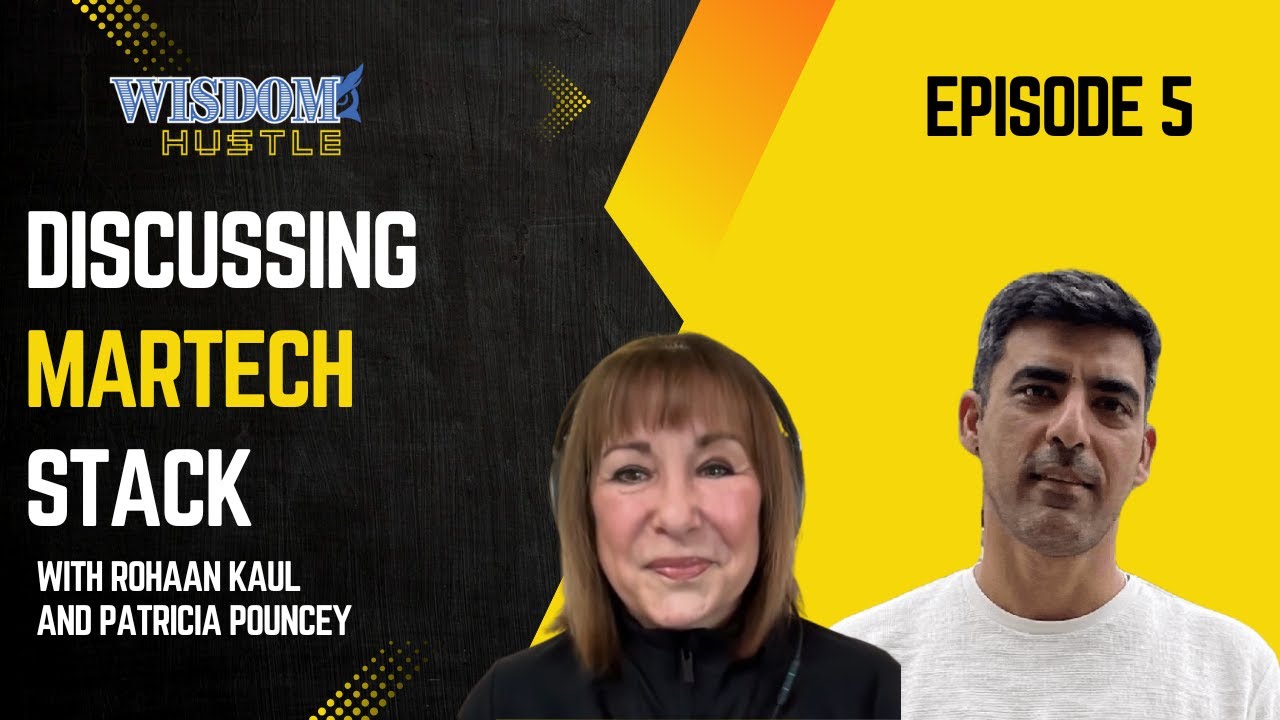
Discover how B2B tech companies can build a future-ready martech stack and stay ahead in the age of Gen AI. Gain practical insights on adapting technology, optimizing marketing operations, and driving long-term growth.
Hosted by
Rohaan Kaul (00:00.494)
Hello everyone, this is Rohan here, the co-founder of ZivOps back. And this is another installment of our series, which is Martech 2025. Today on our panel, we have a guest from across the seas from United States. I have Patricia Ponce, hope I got that right. She's the founder of Ponce Consulting. She's somebody who's
The whole agency is working on growth marketing strategies, especially for
technology startups, B2B technology startups, that's her domain. She's worked for a fairly long time with companies like Converseica, Symfony, Electric Cloud, Elastic, D-Labs, which mostly have been into the B2B domain. And today we are going to have a conversation with her on the emerging trends in martech and how B2B startups can actually look at building and scaling their martech stack in 2025. Hello, Patricia, how are you today?
Patricia Pouncey (01:03.726)
Hey, I'm good. Thanks for having me on.
Rohaan Kaul (01:07.498)
Welcome, it was really wonderful of you to take out time for our podcast for this audience. of them might be your competitors too, but that's really thoughtful of you to give it back to the community. All right.
So before I see that you're a purist in marketing, unlike us, I sort of call myself as a pseudo marketer because I'm a techie who's turned into marketing and then the tech side of marketing because it came naturally from because of my qualification. You've been somebody who's into, who has a qualification in marketing, I guess. So tell us about your journey in marketing in Martech. How has it been?
Was it by choice that you wanted to do marketing from the outset of your career or is it something that came later?
Patricia Pouncey (02:01.666)
Great question. I think it was curiosity more than anything as I started working for tech companies, mostly in the Bay Area, but the companies that had a footprint in California. It's definitely a learning experience. The tools that we're using even a decade ago, we were saying we're game changers at the time. It's those experience that drive revenue depending on which companies you're at.
And I definitely believe that we're at an interesting crossroad. think that the marketing landscape now is shifting within that automation and AI driven tools.
Rohaan Kaul (02:41.838)
Alright, so I was very curious about your experience at Converseka. Could you dig into more details of how was working at that? Was it at the startup stage that you joined them? Like how was it?
Patricia Pouncey (02:57.678)
Yeah, Converse Likha was already well established when I joined. I headed up their demand gen and marketing integration back in 2019, 2020. And they were really on the cutting edge. We say it was conversational intelligence. Some people might call that a chat bot. Some people may say that's text. I think it's all of that. And our product actually
was the SDR BDR function. was someone that would stay in touch with you when you first visited the website to offering up additional content that you could find in our resource center to even being at a point where they would book a meeting. We would get meetings booked and that's when the handoff would go from BDR SDR over to the account executive. It was very interesting because we saw.
40 to 50 % growth just by using automation and by using, which was basically AI at the time. Sure, it's improved now since then, but it was highly effective and successful in driving, I would say sales-qualified leads, going straight to the A, because we knew what the targets were, we knew which accounts we were going after, and so it was almost seamless. I'll have to mention at the time, they also rolled out account-based marketing for the first time, and we had
corporate governance, had the entire executive team and the head of sales pushing for it. So I see that as being more successful when you have tools right out of the gate that are aligned with the same corporate governance at the company where you're at. And that was true, no more so true than at ConverseLika.
Rohaan Kaul (04:34.99)
All right. The reason I asked is because I think to Converse Sika as such, it would be a part of a MaTeX stack. I mean, if somebody were to design, right. So given that experience, we are at cusp of something really interesting that has been happening for past year or so. So in 2025, what do you see is the evolution of MaTeX space? From a technology point of view, what do see people doing in terms of
of incorporating something new in their tech stack. So what are the three, four broad trends that you see in terms of evolution of the MyTech stack in 2025?
Patricia Pouncey (05:17.024)
Yeah, I think it's shifting rapidly. And I think it's shifting rapidly within automation and also AI-driven tools. I believe that technologies will enhance personalization at scale. It will also allow teams to deliver hyper-targeted experience across channels. Whereas AI will definitely streamline content creation and enable faster production of certain channels, paid ads, emails, and social media. It's really going to do a great job of tailoring it to target audiences.
I think another area that's going to improve is predictive analytics. think that we're going to see a refinement in decision making while the automation will optimize campaign management and reduce manual tasks. I also think, and I've heard it buzzed around the ethical considerations of using AI and data privacy. I think there'll be greater oversights that'll be needed. I also think that as these tools evolve, marketers must balance leveraging AI for efficiency.
while maintaining authenticity and creativity, ensuring more genuine connections with our customers.
Rohaan Kaul (06:23.608)
Right, think so there's definitely with the evolution of any technology, right? There is some discussions around regulation, compliance, ethics of it, because even when we had this great data revolution back with the advent of cloud and everything, when we started saying that data is a new oil, I remember I was part of a team in a company where GDPR was launched.
and we had to pivot from something really different in terms of practices and everything and was said that it's kind of very stringent in nature and but from a point of view like how data was being used and evolved and how there were some ethical implications of which brought this and I think so now even in other countries
similar something is happening like you know I think so few years back when you had something in US which is the CCPA which is exclusively the California state so I hear you I think so on the AI front also where do you think like you know there are gray areas in the AI right now at this point of time especially from a martech point of view
Patricia Pouncey (07:43.56)
I'd like to see more done. I sat in on Dreamforce, Salesforce, and their AI agent was highly exciting. I think that it also adds additional capabilities to access information. Data certainly is a part of that. Also making decisions and taking actions autonomously. It's more like a self-driving car. An example would be an AI support agent that accesses product docs. It provides step-by-step. This can be through the chat bot or through a text.
It could do troubleshooting, then it also schedules human intervention when necessary. So it's saving a lot of that human time by using the AI agent or automation, large language models, to do most of the busy work before you get to that point. So there's a lot of removal of friction and streamlining that process. I also think that in 2025, we're gonna see enterprise adoption of AI agents move beyond proofs of concept. know Deloitte predicts 25 % of enterprises using general AI.
and we'll deploy agents in next year.
Rohaan Kaul (08:46.474)
Interesting. So in context like, know, when we are seeing that even the enterprises are going to adopt AI, mean, so for startups, like, you know, coming forward in B2B, let's talk more in context of, let's say B2B technology startups or any technology startups. you know, because they are selling technology in, so the expectations of the customers are always, you know,
Patricia Pouncey (09:14.924)
or front.
Rohaan Kaul (09:15.242)
sky high like I know from the level we've talked about lean startups where we talked about MVPs but the customer experience expectations have like shot through the roof like you know I mean everybody's expecting that aha moments we talk about hyper personalization now for a startup right just taking baby steps right now just moving along what do you think is the right
Patricia Pouncey (09:35.918)
Bye.
Rohaan Kaul (09:42.138)
One is what would be the right tech stack to start off with, right? To basically get their foot in the door or get, you know, ensuring that there's a balance between things like, know, and what are the key categories of martech tools that you would recommend that, you know, a startup should have starting in 2025.
Patricia Pouncey (10:02.574)
That's a good one. Well first and foremost you have to be organized I've seen people use money calm or right To be sure that the projects are aligned that they have all their resources and you can see it from a timeline I Am a big believer in marketo, but I've also used HubSpot I know a lot of startups use HubSpot because it's easier to get it up and get it running and get the information Over to the sales team they can get their programs up really quickly
Usually when they scale or get a little bit bigger, I see them going for other tools like Marketo because it's multifunctional scale exponentially. I also think that the teams are going to start looking at AI teammates that are going to help the MOPs team escape technology trenches. And I think they're going to focus on strategic innovation for business in certain areas.
I think automation is key for audience building and segmentation. Data cleansing and enrichment is super important and it should be talked about more than it currently is. Unless you have the right data, you're not gonna target the right audiences. So I think that that almost has to happen first. Campaign and program build out based on prompts or brief is gonna be taken over by some type of automation too as well.
The creation of multi-versions for different segments is gonna be key. We're past A-B testing. We have to be able to look at target audience and what their pain points are. And then just KPIs and analytics of campaigns, accounts and contacts that everyone can see on a 24 by seven basis, whether that's dashboards, whether you've built out something in Domo, 5Trans, Snowflake. You just need to have something where you're looking at all your systems so you can make sense of.
revenue generation, which programs are generating and turning off the ones that aren't and tech will assist us there. I also think that they should be considering any MarTech with strong APIs. You have to connect all your tools. Perhaps we're leading into a headless MarTech trend and just using high quality data foundations. That's what it looks like 2025 is coming into. But of course, know, month by month it could change, but it looks strong for 2025.
Patricia Pouncey (12:20.13)
People are figuring this out. think that buzzwords, AI, and LLMs are going to cool a bit. They've been in products I've used for years, but now they're coming to the forefront. whether it's software as a service is now service as a software, we're going to get there, but it's going to be more streamlined. And I think these tools initially will augment the current team so that they could focus on strategy.
Rohaan Kaul (12:44.716)
Right, right. think so that's fairly very good insights into the focus is on strategy and AI is going to take care of a lot of stuff. I mean, the other part, while I was listening to your conversation, I mean, with the points that you put forward. Now the question is that for a startup, it's always about evolution, right? There's low and I mean, there could be fast progress, slow progress, right?
So starting with the bare basics to taking it as your startup grows, need to scale things, scale processes, right? So what's the right approach in that scenario? Like how do you do it? Because one, the technology landscape is also changing at a very fast pace, right? And you mentioned about some of these tools there is.
considerable amount of effort that goes into building these stacks also like we know with the integrations we do have native integrations for a lot of them, but it still takes a sizable effort to do that. Now in that scenario, what's the strategy now like, know, to one is to respond to these changes that may happen and at the same time taking, you know, as the company grows scaling it. So how do you strike, you know, how do you, how do you make sure this is done?
Patricia Pouncey (14:02.326)
Balance, right. You don't wanna over purchase. So many of the tools out there wanna sell you their pro version where their basic version would get you up and running. So I'd go back again to HubSpot, making sure all your data is coming in from sources that have been double opted in or double opted out. Data info is great at that. I also think, or Zoom info is great at that.
because they'll cleanse your data, they'll also cleanse it while you're in your system. If you can just get an accessible and consistent data tool that has enough of your target audience in it and stand up HubSpot, you don't need a lot of people to do it. Again, here's where experience, they should prioritize experience and skills, because that's what's going to build your strategy right out of the gate.
and get those connected. It's just basically training, making sure that the sales team's on board, everybody's looking at the same revenue strategy. And then starting smaller programs. Most of it's gonna be awareness if you're a new startup. If you're a midway, now you're targeting folks that are looking like they are showing some purchasing cycles. You can also build ABM out of HubSpot. You don't have to buy an ABM tool right out of the gate, but if you're scaling pretty quickly,
and you want that streamlined effect or you now have governance from your board or venture capital that it's time to go 3X, 5X, then you need the tools that are gonna get you there. I would not over purchase tools. I would get the people with the experience and the skills and I would say data literacy is critical because you have to interpret the analytics, you have to measure the performance and you have to extract those actionable insights. I think technical proficiency in analytical tools.
and sure is an efficient stack utilization. You wanna try to remove the friction if there's an existing tech stack, just remove the friction. It's not about scrapping it and starting over, but you do wanna save the things that are working and then start building on for the ones that you don't. And I think teams should also focus on consistent collaboration in project management. Sometimes early on, it's not so siloed, but as they grow, sometimes it is. So you wanna be sure you're fostering a community where everyone's working together for the right reasons.
Patricia Pouncey (16:20.682)
I also think that a culture of continuous learning, you know, you always say CI, CD, or continual development empowers team to stay agile. I think that that's a key in being successful and adopting, know, whereas you're adopting the new technologies, just constantly maximize the stack potential in a dynamic shifting, interesting landscape. And that's what we're going to find in 2025.
Rohaan Kaul (16:45.996)
I like how you mentioned about over purchase because, then, you know, we always suffer from shiny objects syndrome. And I find that in Martek, there's a lot of it, like the shiny object syndrome. So how do we, you know, how do we stay clear of that?
Patricia Pouncey (17:02.318)
Well, one thing I would and I've always done it is don't sign up for more than a year. They'll throw all kinds of price reductions and price considerations at you and ask you to sign up for two years. You're going to need it. Well, no, you won't because after a year you may figure out how to do 50 % of it on your own by automation or AI and you won't need it. And lot of these contracts come with a, you you can't cancel clause. And it's, that sometimes can hamper startups when they're just about ready to grow and they need to.
another tool to scale faster. Sometimes a year with the tool, you're done and you're ready for something else that's gonna speed you along. So I would not sign anything for more than a year and then start slow. You need more paid programs right out of the gate. You've gotta get other content on sites other than your website, whether it's, I've used a couple of them, DemandWorks, Infosys, Infuse.
These can find the folks that you are also targeting, but it's not necessarily on your website. But they can get you over to their website. So you want to take your content. Infuse is a perfect example. They're going to reach out to your target. It's going to be automated. They're going to be able to push those leads right into your system. Gone are the days that we're doing CSV downloads on lists. That's the crucial part of how automation can help get you there sooner, faster. But you have to do your due diligence. And the disposition is key. You can't bring these leads in and then not work them.
That's paramount and I think the teamwork between marketing and sales is paramount with this and reaching across the aisle to be sure that A, you're giving them everything that they need to be successful. I know the one tool that the sales team has told me has been worthwhile is getting some kind of additional information so they feel confident when they get on that first initial phone call where they're trying to figure out what their pain points are. Certainly they're doing some
farming and hunting, but marketing can help them by providing additional information that they may not have. And that's the key. Really it's only marketing's position is help me, to the sales team, help me run more of the programs you deem are successful by version of picking that up and working it all the way down to either close one or close loss. That's really the key. I'll always say it, marketing does not create revenue, but it does create opportunities for revenue and potential revenue.
Patricia Pouncey (19:27.16)
So that relationship, and I've worked on that substantially with the sales teams because it doesn't matter, it will never matter what program or campaign you run because if the sales team hasn't picked it up for disposition that they're just gonna sit there. So let's be sure that we know that that's ultra critical to be on point. Because sometimes things can't pivot and shift. In these programs, every 30 days you should be going through and QA-ing, making sure there's no issues. That's how you catch it. I do a QA session first thing in the morning with my coffee, just checking it out.
Rohaan Kaul (19:30.68)
Right.
Rohaan Kaul (19:49.582)
Mm-hmm.
Rohaan Kaul (19:53.89)
Mm-hmm. Yeah.
Patricia Pouncey (19:56.27)
Those are some of the things I think they're going to be ultra critical for 2025.
Rohaan Kaul (20:01.474)
Yeah, think so that's a super good practice to have. Now, last question before we wrap up. Now that we've talked about people who are building stacks right off the bat in 2025, let's talk about companies who are fairly mature in B2B marketing, maybe not at the startup stage, they already have a stack in place.
So what do you think in terms of making changes in 2025? What is the additional considerations or any changes that you foresee them doing in 2025 in their current stacks and anything that you see on scaling or rescaling of their teams?
Patricia Pouncey (20:44.15)
Yeah, those are all great questions. I think we need to start doing a better job at doing right by the customer. I think we need to attempt to reframe where companies go for their tactical pipeline creation. Demand gen definitely at the forefront, but also the strategic voice of the market and the customer. And it isn't really about abandoning revenue responsibility, but recognizing that long-term revenue growth comes from deeply understanding customers and building those strong demands.
If we go back to talking about 5 % of the buyers actively being in market, then the brand perception determines who makes the short list and wins. 80 % of the buyers are aware of us even before doing some of the research. I also think that 2025 innovators will start moving budgets towards brands. They're going to start heeding the advice of the Bitnet and the field who suggests 46 % brand and 54 % to demand gen for B2B in 2025.
Rohaan Kaul (21:26.221)
Right.
Patricia Pouncey (21:41.198)
So now we see that shift, whereas we thought demand gen was all of it. You've got to really be on pointing on brand. And if you are, that message is going to resonate with that customer. So you're still going to push for demand gen. 54 % is still strong, but it's not 100 % game anymore. You really have to spend a lot of time putting content with the brand, with the pain points, solving those issues. One of the developers that I worked with used to tell me, Patricia, don't be disingenuous.
If you're gonna go out, just tell folks what you're good at. Just tell them what you're good at. Save them time because they're busy and the reason they're gonna buy you is either you're gonna solve an issue, save them time, save them money if they're transitioning from another tool. So you wanna be focused on that brand, on the folks that look like they're interested in your product or service. But also remember, you've also gotta go out of the top of the funnel, which is 54%. So I think it's gonna be kind of a 40 to 50 % split between brand and demand gen.
Rohaan Kaul (22:23.085)
Right.
Patricia Pouncey (22:37.794)
But like I said, I just think AI and large language models are just going to add those capabilities to access information, make decisions, and take actions autonomously.
Rohaan Kaul (22:48.492)
All right, interesting. Thank you. That was great insights. Now, before we say goodbye, any message for the marketing community for 2025, the fellow marketers who will be listening to this podcast, anything that you'd like to say to them.
Patricia Pouncey (23:05.888)
Yeah, I would say just those group meetings, the group meetings and the meetings with sales. I myself used to sit in on BDR and SDR meetings. I used to sit in on the AE meeting when they let me in. I used to sit in on the finance meeting just so you could see, you can experience how the leads are coming through. Sometimes you can see a friction point. I'll go to someone and say, what more do you need for this to not take a day, for this not to take two days? Or is it more automation? Is it more nurture, right? But I just think it's...
Rohaan Kaul (23:30.67)
Right.
Patricia Pouncey (23:35.818)
More working together, it's not so much as silos, it's not so much with politics, it's people owning their jobs and sometimes folks that have been in their positions for a while maybe aren't as flexible or adaptive and for the new folks sometimes that can be frustrating. So what I would say is, know, continually working together, checking in, it's also, you know, top down, a lot of it has to do with the upper management.
and also the boss, your upper manager. I myself have been very fortunate to work with really good managers, not only from a learning opportunity, but a chance to grow and stretch. for those, I would say for those managers out there that have teams, VP, SVP, heads, check in with your teams. You can do a quick 360 on a call. And also remember, sometimes an email will suffice where people are putting meetings. Let's not just throw a meeting up on the calendar that sometimes can waste time.
I think folks on this call will appreciate where we're spending a lot of time in meetings and then after we leave work, now we're working on our staff, right? So think about is can that meeting be an email? And can we just quickly, it's very agile, go around. What I like to do is do a startup first day of the week and then Friday to toggle it off. You can easily find out what's causing friction. Where do you need help? That, you know, and maybe some people don't, are more afraid to raise their hand on a Slack channel.
But if somebody's in a standup and say, do you have any difficulties? Is there something you're currently waiting on? That sometimes can move people very quickly and get the information they need so that they don't feel like they're bottlenecked and perhaps don't feel a willingness to raise their hand. So just removing that friction either between folks or between tools. Regularly check in to be sure everybody's on point. And if you can, you have extra time. Help somebody else that looks like they.
may have a lot on their plate. And one or two things that you could take over, puts them in a better light and makes a team stronger, right?
Rohaan Kaul (25:34.976)
All right, yeah, thank you. I actually used to do that. I used to at times, you know, make a spreadsheet of the time that my team spent in meetings and used to give my manager the cost for it. That sometimes it's, you know, just look at it. Yeah.
Patricia Pouncey (25:47.574)
And just thinking, just think people, it's gold. Yeah, we are all chasing money and equity and bonuses and that. But when somebody takes time in either a meeting or a Slack channel to praise you, it's everything. You don't know what's going on with people. And just have that little bit of confidence on something you put together. It might seem small to you, but it might have unstuck something for someone else and allowed four more things to get completed because they weren't waiting on something. Communication is key. So don't be afraid to speak up.
Rohaan Kaul (26:10.466)
Right.
Patricia Pouncey (26:15.246)
even if you think it's going to be a critical conversation, sometimes those need to be had.
Rohaan Kaul (26:19.65)
Yep, I know, I agree. All right, Patricia, that's the end of our show today. Wonderful insights, I had great fun talking to you. mean, especially the fact that I also spend a large part of my life doing B2B marketing. So this was especially like talking to Pierre, a lot of insights that I got. So this was fun. And...
Since we are at the end of the year also, I want to wish you a very successful 2025 and hope you and your family have a great 2025. May it be successful for everyone in your family.
Patricia Pouncey (26:58.764)
you as well. We're all looking forward to that.
Rohaan Kaul (27:01.378)
Yeah, everyone is. All right, thank you. Have a great day ahead. Thanks.
Patricia Pouncey (27:05.74)
You too. Bye.