Search engine optimization has undergone a significant transformation over the past decade. By 2026, on-page SEO is no longer limited to inserting keywords into content or adjusting meta tags. Modern search algorithms evaluate websites through a far more sophisticated lens that includes semantic understanding, search intent, user experience, and content credibility. As artificial intelligence and machine learning continue to shape search engines, businesses must adopt a more strategic and research-driven approach to on-page optimization.
Organizations that succeed in search visibility today focus on building authoritative content ecosystems rather than isolated pages. Effective on-page SEO integrates content strategy, technical optimization, and user-focused design to create pages that are both discoverable by search engines and valuable to human readers. For companies seeking sustainable organic growth, implementing a comprehensive on-page SEO strategy has become one of the most important components of digital marketing.
A critical starting point for on-page SEO in 2026 is the development of an intent-driven keyword strategy. Search engines now prioritize understanding the purpose behind a user’s query rather than simply matching keywords. This shift requires businesses to analyze whether a searcher is seeking information, comparing solutions, or preparing to make a purchase. Instead of focusing solely on high-volume keywords, modern SEO strategies incorporate semantic variations, long-tail phrases, and contextual entities that help search engines interpret content more accurately.
Mapping keywords to specific pages also plays a vital role in avoiding keyword cannibalization and strengthening topical authority. When organizations group related keywords into structured topic clusters, search engines can more easily recognize expertise within a particular subject area. This approach signals authority and improves the likelihood of ranking across a wider range of related search queries.
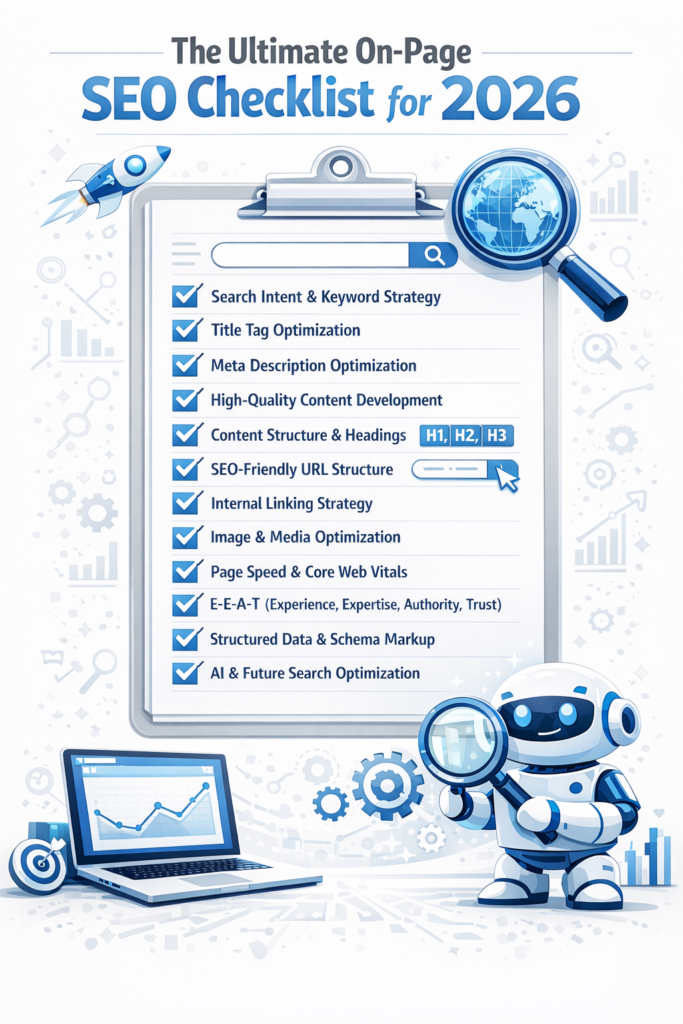
Another essential element of on-page SEO is the optimization of title tags and meta descriptions. Although these elements are relatively small in terms of content length, they play a significant role in shaping how pages appear within search results. Well-crafted title tags communicate the relevance of a page to both users and search engines, while meta descriptions influence click-through rates by providing a concise preview of the page’s value. Effective titles typically include primary keywords in a natural context while remaining clear and engaging for users scanning search results.
Content quality remains one of the most influential ranking factors in modern SEO. High-performing pages consistently demonstrate depth, clarity, and comprehensive coverage of a topic. Rather than producing short articles that only partially address a subject, successful websites focus on creating detailed resources that fully answer user questions and provide meaningful insights. Research indicates that longer, well-structured content often performs better in search results because it satisfies user intent more effectively and encourages longer engagement times.
Equally important is the structural organization of content. Search engines rely heavily on page structure to interpret the hierarchy and relevance of information. Proper use of heading tags allows both users and algorithms to navigate content more efficiently. A clear hierarchy beginning with a single H1 heading and followed by logically arranged H2 and H3 subheadings helps establish topical relationships within the page. Well-structured content not only improves readability but also increases the potential for appearing in featured snippets and AI-generated search summaries.
URL structure is another often overlooked component of on-page SEO. Clean and descriptive URLs improve both usability and search engine understanding. When URLs clearly reflect the subject of a page, they provide additional context that can reinforce keyword relevance. Short, readable URLs that incorporate primary keywords tend to perform better than long, complex URLs filled with parameters or random characters.
Internal linking represents one of the most powerful yet underutilized on-page optimization techniques. By strategically linking related pages within a website, businesses help search engines discover and index content more effectively. Internal links also distribute page authority throughout a site, strengthening the visibility of important pages. When implemented within a topic cluster framework, internal linking reinforces the relationship between supporting articles and core pillar pages, ultimately improving rankings across an entire subject area.
Visual elements also play an increasingly important role in on-page optimization. Images, graphics, and other media improve engagement and make complex information easier to understand. However, these elements must be optimized carefully to avoid negatively affecting page performance. Proper image compression, descriptive file names, and relevant alternative text ensure that visual content contributes positively to both accessibility and search visibility.
Page experience has become another major ranking consideration in recent years. Modern search engines evaluate how quickly pages load, how responsive they are to user interaction, and whether visual elements shift unexpectedly while loading. These performance metrics, commonly known as Core Web Vitals, directly influence how search engines assess user experience. Websites that load quickly and maintain stable layouts tend to retain visitors longer, which can positively influence overall search performance.
In addition to technical performance, search engines increasingly evaluate the credibility and trustworthiness of content. The concept of Experience, Expertise, Authoritativeness, and Trustworthiness, often referred to as E-E-A-T, has become a central component of modern search quality evaluation. Websites that demonstrate real expertise through well-researched content, credible authorship, and transparent information tend to perform more consistently in competitive search environments. Providing author credentials, real-world examples, and supporting data can significantly strengthen these authority signals.
The growing role of artificial intelligence in search results has also introduced new opportunities for structured content optimization. Structured data, commonly implemented through schema markup, allows search engines to better interpret the meaning of page elements. When implemented correctly, structured data can enable enhanced search features such as rich snippets, knowledge panels, and question-and-answer results. These enhancements increase visibility within search results and can significantly improve click-through rates.
As AI-generated summaries and conversational search interfaces become more common, structured and well-organized content will become even more valuable. Pages that clearly define topics, answer questions directly, and present information in an accessible format are more likely to be referenced by AI systems when generating search responses.
Ultimately, on-page SEO in 2026 requires a holistic and research-driven approach that combines technical optimization, high-quality content creation, and user-focused design. Businesses that view SEO as a continuous process rather than a one-time task are better positioned to adapt to evolving search algorithms and shifting user behaviors. By prioritizing relevance, authority, and user experience, organizations can build a strong foundation for sustainable organic growth.
For companies seeking to increase online visibility, generate qualified leads, and strengthen digital authority, a comprehensive on-page SEO strategy remains one of the most effective long-term investments in modern marketing.