How to Rank Inside AI Search Results (Not Just Google)
Ranking #1 on Google is no longer the end goal because AI answer engines like ChatGPT, Google AI Overviews, and Perplexity are now summarizing results instead of listing them.
And here is the shift most marketers are missing:
You are no longer optimizing for clicks. You are optimizing for citations inside answers.
This is where Answer Engine Optimization (AEO) and GEO (Generative Engine Optimization) come in.
The New Ranking Model: From Links to Citations
Traditional SEO worked like this:
Rank high → get clicks → convert traffic
AI search works differently:
Be cited inside answers → build trust → capture high-intent users
Data shows:
- Up to 40% increase in AI visibility when content includes structured citations, stats, and quotes
- 58% of marketers report higher conversion rates from AI-referred traffic
- Some brands saw +600% increase in AI mentions after optimizing for citation signals
This is not incremental. This is a new distribution channel.
Core Insight: AI Engines Rank Structured Authority, Not Just Keywords
AI systems do not rank pages. They select fragments of content.
They prefer content that is:
- Structured (FAQ, lists, tables)
- Authoritative (cited, factual)
- Contextual (geo and intent aligned)
Flowchart: How AI Search Actually Works
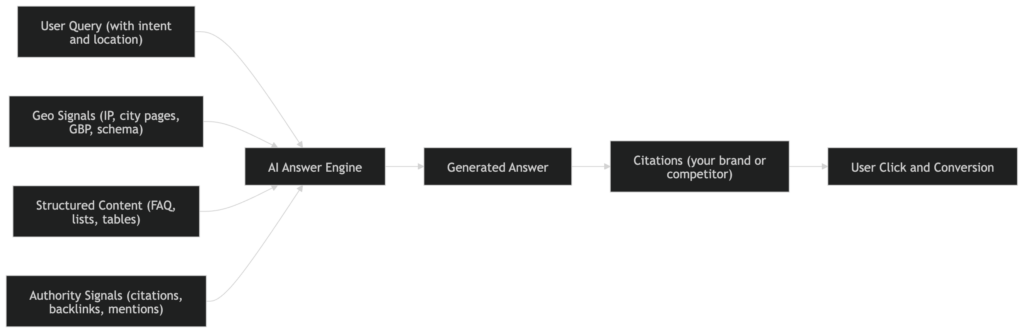
GEO Strategy: Why Location Still Matters in AI
AI models still rely heavily on geo signals, especially for commercial queries.
Key GEO signals include:
- Google Business Profile completeness
- LocalBusiness schema with coordinates
- City-specific landing pages
- Local backlinks and citations
A case study across 27 local sites showed:
- 197% average traffic growth using geo-targeted content
There is also a critical nuance.
AI models experience something called geo-identification drift. If your content is not explicitly localized, AI defaults to global sources.
The result is simple. You lose visibility even if you rank locally in Google.
Citation Optimization: The Real Ranking Factor
AI engines do not just retrieve information. They justify answers with sources.
Citation patterns show:
- Around 85% of AI answers cite content already in top 10 results
- About 78% of AI responses use list formats
- Nearly 47% of citations come from highly structured sources
The implication is clear.
If your content is not structured like an answer, it will not be selected even if it ranks.
The Highest-Performing Content Format
Winning structure:
- Question as heading
- Direct answer in 2 to 3 lines
- Bullet breakdown
- Supporting stats or references
Example:
What is AEO?
AEO is the process of optimizing content to be directly cited in AI-generated answers rather than just ranking in search engines.
- Uses structured formats like FAQ and lists
- Prioritizes clarity over keyword density
- Increases AI visibility by up to 40 percent
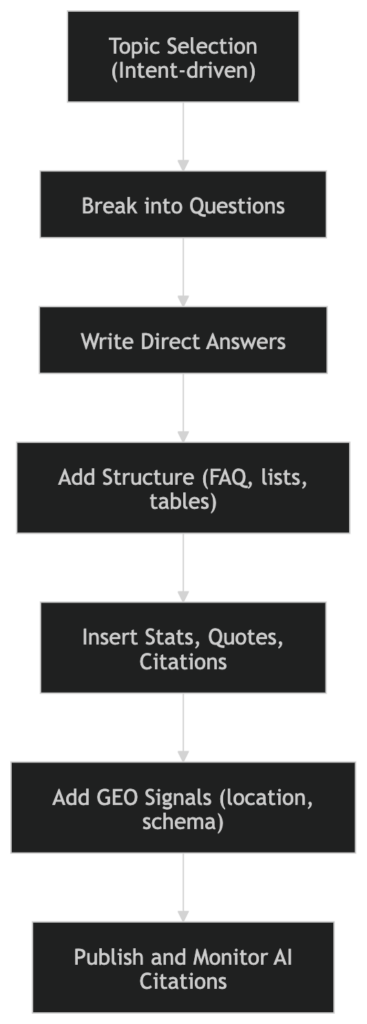
Flowchart: AEO Content Optimization Framework
Tactical AEO and GEO Stack With Expected Impact
FAQ schema and Q&A formatting
Expected uplift: 30 to 60 percent AI citations
Reason: Matches how AI outputs answers
Answer-first content
Expected uplift: 20 to 50 percent inclusion rate
Pages that start with answers get cited more often
GEO pages with city-level targeting
Expected uplift: 100 to 200 percent traffic in local niches
Works best for service businesses
Adding statistics and external references
Expected uplift: Around 40 percent more AI visibility
AI prefers verifiable content
Third-party mentions across platforms
Expected uplift: 30 to 60 percent more brand citations
Example: One SaaS brand increased mentions by 600 percent
The Hidden Lever: Narrative Control Outside Your Website
AI does not rely only on your site. It pulls from multiple sources such as:
- Quora
- Review platforms
- Industry blogs
This leads to a critical realization.
Your brand perception in AI equals what the internet says about you.
A real pattern observed:
Before optimization: competitor mentioned 73 percent of the time
After optimization: brand visibility significantly improved
Conversion Advantage: Why AI Traffic Performs Better
AI traffic behaves differently.
It comes after:
- The user already receives an answer
- Your brand is positioned as a trusted source
This creates:
- Higher trust
- Lower friction
- Faster decisions
Result: higher conversion rates compared to traditional SEO traffic.
The Strategic Shift You Need
Old SEO mindset
Keywords → rankings → clicks
New AI search mindset
Questions → answers → citations → conversions
Final Takeaway
If you want your blog to convert in 2026:
Do not just rank. Get cited.
Because in AI search:
Visibility comes from inclusion in answers
Authority comes from structured clarity
Conversions come from trust at first interaction