Search is undergoing one of the most significant transformations in its history. For over two decades, the dominant model has remained largely unchanged. Users entered a query, reviewed a list of links, and navigated across multiple websites to find relevant information. Success for businesses and creators depended on ranking high enough to earn clicks.
That model is now rapidly evolving.
AI-powered systems such as Google AI Overviews, ChatGPT, and Perplexity are fundamentally changing how information is delivered. Instead of presenting a list of links, these platforms generate complete, synthesized answers directly within the interface. Users increasingly receive what they need without visiting external websites.
This shift marks the transition from search engines to answer engines.
As a result, a new discipline has emerged: Generative Engine Optimization (GEO). GEO is not focused solely on visibility in search results. Its goal is to ensure that content is selected, interpreted, and cited within AI-generated answers.
Understanding how GEO works is essential for anyone looking to maintain visibility in this new environment. This article explores the mechanics behind AI search, the implications for content strategy, and the practical steps required to succeed.
What is Generative Engine Optimization (GEO)?
Generative Engine Optimization is the practice of designing content so that it can be effectively used by AI systems during answer generation.
At its core, GEO focuses on three outcomes. Content must be easy for AI systems to find, simple to extract, and reliable enough to include in a generated response.
Traditional SEO emphasizes ranking factors such as keywords, backlinks, and technical performance. While these elements remain important for discoverability, they do not guarantee inclusion in AI-generated answers.
GEO introduces a different success metric. Instead of asking whether a page ranks first, the more relevant question becomes whether the content appears inside the answer itself.
This shift redefines visibility. A page that is not ranked first can still achieve high exposure if its content is consistently selected and cited by AI systems.
How AI Search Works: The RAG Model
To understand GEO, it is necessary to examine how modern AI search systems function. Most platforms rely on a framework known as Retrieval-Augmented Generation, commonly referred to as RAG.
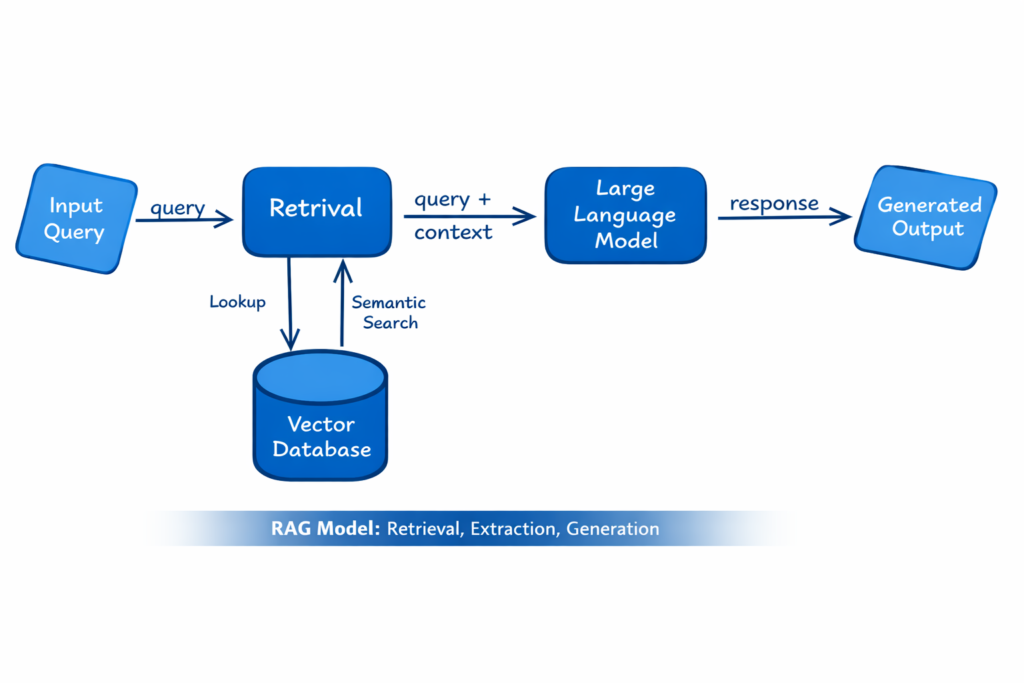
This model combines information retrieval with generative AI to produce accurate and contextually relevant answers. The process can be broken down into three key stages.
1. Retrieval
In the first stage, the system scans a large pool of information sources. These may include web pages, structured databases, knowledge graphs, and other digital content repositories. The goal is to identify material that is relevant to the user’s query.
Unlike traditional search engines, which rank results based on relevance signals, AI systems focus on gathering a diverse set of potentially useful sources.
2. Extraction
Once relevant sources are identified, the system extracts specific pieces of information that directly address the query. This stage is highly selective. Content that is clearly written, well structured, and directly answers the question has a higher likelihood of being chosen.
Ambiguous or overly complex passages are less likely to be used, even if they contain valuable information.
3. Generation
In the final stage, the AI synthesizes the extracted content into a cohesive answer. It may combine insights from multiple sources, rephrase sentences, and present the information in a conversational format.
This process highlights a critical distinction. AI systems do not simply display content. They interpret, reorganize, and reconstruct it. As a result, content must be designed not just for human readers, but also for machine interpretation.
The Rise of Answer Engines
The emergence of answer engines represents a fundamental shift in how users interact with information online.
In the traditional model, users played an active role in evaluating sources. They compared different perspectives, assessed credibility, and formed their own conclusions. This process required time and effort.
Answer engines simplify this experience. By aggregating information and presenting a unified response, they reduce the need for users to navigate multiple sources. While this improves convenience, it also changes the dynamics of visibility.
Zero-click searches are becoming increasingly common. Users receive complete answers without leaving the platform. For content creators, this means that traffic is no longer the only indicator of success.
Instead, the focus shifts to influence. Being included in an AI-generated answer can shape user perception, even if it does not result in a direct visit to the source website.
The GEO Framework: Optimizing for AI Visibility
To succeed in this new environment, content must be intentionally structured to align with how AI systems retrieve and process information. The following principles form the foundation of an effective GEO strategy.
1. Answer-First Writing
Content should begin by directly addressing the user’s question. Each section should open with a clear, concise answer, followed by supporting details.
This approach improves readability and increases the likelihood that the content will be selected during the extraction phase.
2. Structured Content Design
Well-structured content is easier for AI systems to process. This includes the use of headings, subheadings, bullet points, and short paragraphs.
Structure acts as a guide, helping AI systems identify key ideas and relationships between concepts. It also enhances the user experience by making information easier to scan.
3. Creation of Citation Hooks
AI systems often prioritize content that contains clearly defined concepts, frameworks, or terminology.
Introducing original ideas, such as named models or structured processes, can increase the chances of being cited. These elements provide identifiable reference points that AI systems can attribute to a specific source.
4. Clarity and Precision
Clarity is one of the most important factors in GEO. Content should be written in a straightforward and professional tone, avoiding unnecessary complexity.
Clear language improves both human comprehension and machine extraction. It ensures that key ideas are understood quickly and accurately.
5. Layered Information Delivery
Effective content is organized in layers. The first layer provides a direct answer. The second layer offers explanation and context. The third layer includes examples, data, or deeper insights.
This structure allows content to serve multiple purposes. It provides immediate value while also supporting more detailed exploration.
GEO vs SEO: An Evolution, Not a Replacement
GEO does not replace SEO. Instead, it builds upon it.
SEO remains essential for ensuring that content is discoverable by search engines. Without proper indexing and visibility, content cannot be retrieved in the first place.
GEO, on the other hand, determines whether that content is actually used in AI-generated answers.
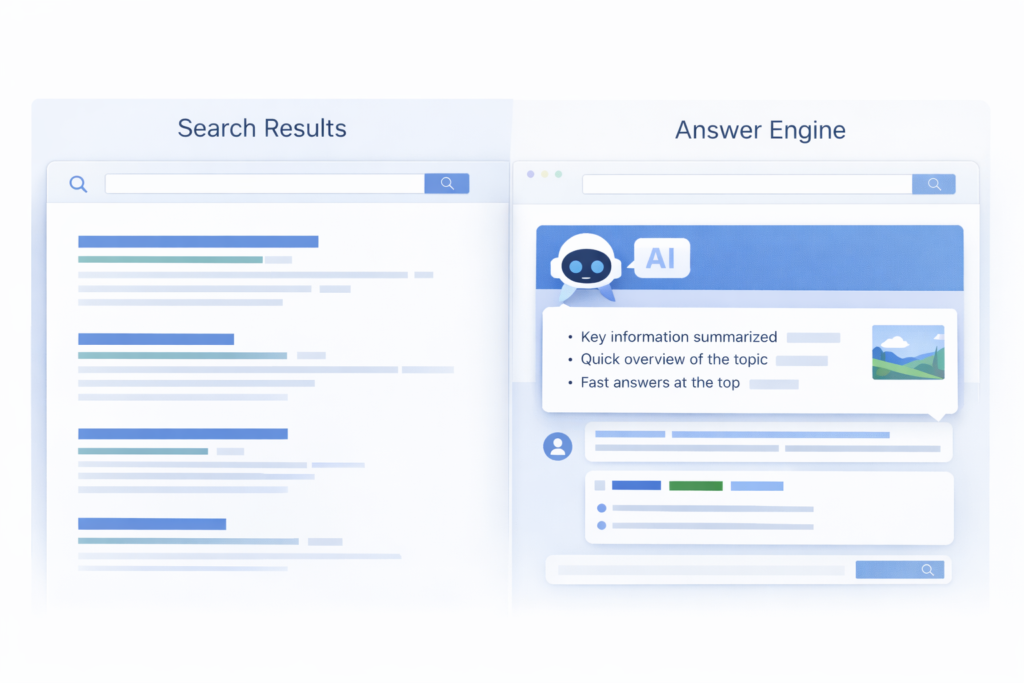
The relationship between the two can be understood as complementary. SEO brings users to your content. GEO brings your content to the user, often without requiring a click.
Organizations that integrate both strategies are better positioned to adapt to the evolving search landscape.
Multi-Platform Optimization
The search ecosystem is no longer dominated by a single platform. Users now rely on multiple AI systems, each with its own approach to retrieval and answer generation.
This diversification requires a broader optimization strategy. Content must be designed to perform well across different environments, rather than being tailored to a single algorithm.
Consistency in quality, structure, and clarity increases the likelihood of being selected across platforms. It also reduces dependence on any one source of traffic.
The Role of Authority and Trust
As AI systems determine which content to use, they place significant emphasis on credibility.
Trust signals play a critical role in this process. These signals may include demonstrated expertise, consistent publishing within a specific domain, and accurate, well-supported information.
Clear authorship and a strong brand identity also contribute to perceived authority. Over time, sources that consistently provide reliable information are more likely to be reused and cited.
This highlights an important shift. Success is no longer based solely on individual pieces of content. It is increasingly tied to the reputation of the entity behind the content.
Content Strategy in a Zero-Click World
The rise of zero-click searches presents both challenges and opportunities.
On one hand, reduced traffic can impact traditional performance metrics. On the other hand, increased visibility within AI-generated answers can strengthen brand recognition and authority.
To adapt, content strategies must evolve. Instead of focusing exclusively on driving clicks, creators should aim to deliver value at the point of discovery.
This involves providing clear, complete answers while also offering deeper insights that encourage further engagement when needed.
Common Mistakes to Avoid
As organizations adopt GEO strategies, several common mistakes can limit effectiveness.
One common issue is prioritizing length over clarity. Long content is not inherently valuable if it lacks structure or focus.
Another mistake is relying too heavily on keywords without considering how AI systems interpret meaning. Semantic clarity is more important than keyword density.
Finally, some creators overlook the importance of originality. Content that does not offer unique insights or perspectives is less likely to be selected and cited.
Avoiding these pitfalls can significantly improve performance in AI-driven environments. For a complete approach, explore this AI search optimization guide.
Conclusion
The evolution of AI search represents a shift from information retrieval to answer delivery.
In this new landscape, visibility is no longer defined solely by rankings or traffic. It is defined by presence within the answers that users receive.
Generative Engine Optimization provides a framework for achieving this visibility. By focusing on clarity, structure, and extractability, content creators can align their strategies with the way AI systems operate.
The key question is no longer whether your content ranks. It is whether your content is used.
When an AI system answers a question in your domain, your goal is to be part of that answer.
Those who adapt to this shift will not only maintain relevance. They will help shape the information that defines it.